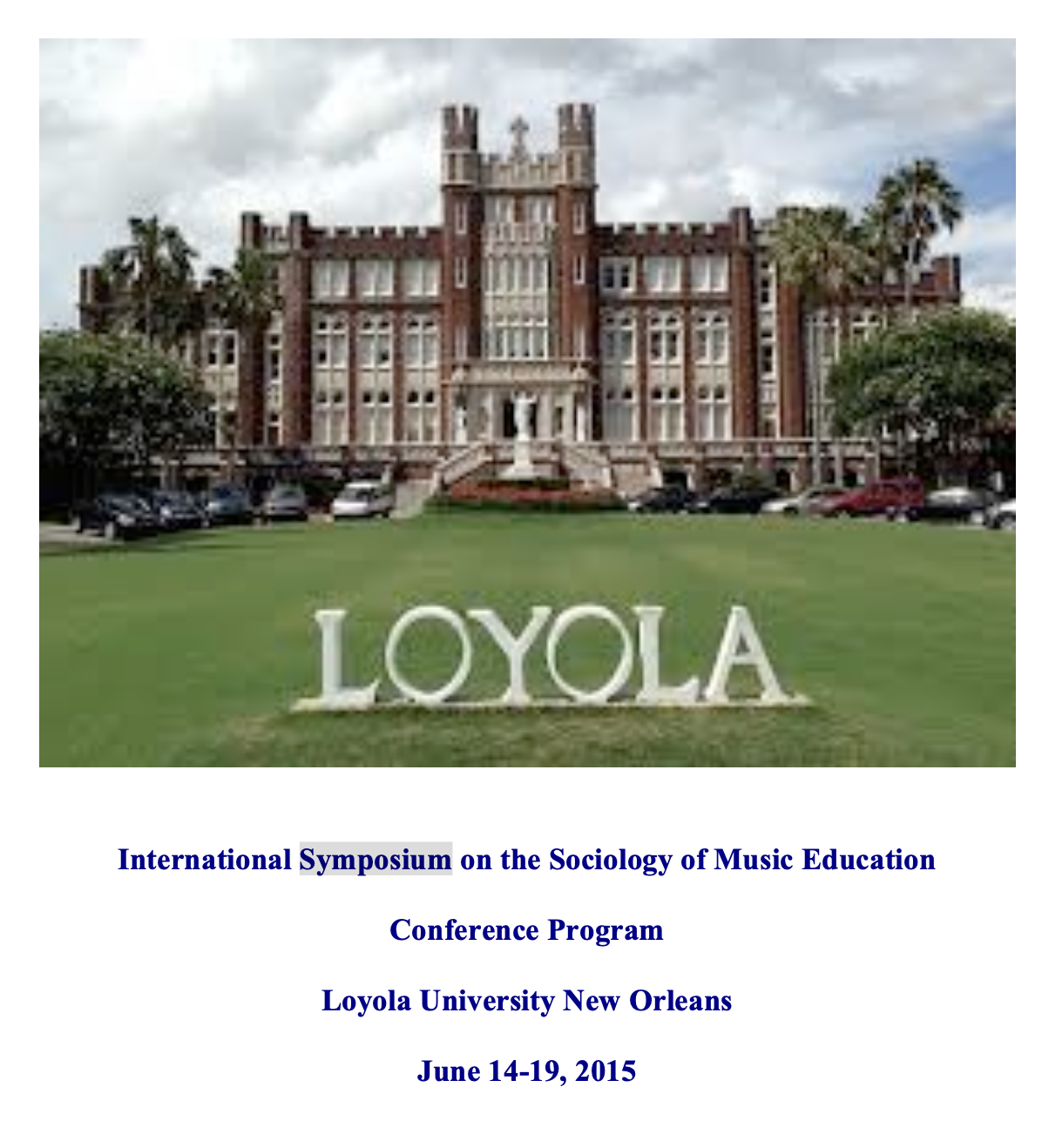
International Symposium on the Sociology of Music Education
Conference Program and Abstracts
On behalf of the faculty, students and staff of Loyola
University’s College of Music and Fine Arts, I am pleased to
welcome ISSME and the MayDay group to Loyola and to New
Orleans. We are thrilled to be your hosts. It is our wish that
you will find our City both hospitable and entertaining, and
that you will return in the near future.
In any case, best wishes for a lively and stimulating conference, and I hope that this
conference will be the first of many international collaborations of music education.
Sincerely,
Anthony DeCuir
Anthony DeCuir, PhD
Dean, College of Music and Fine Arts
Loyola University New Orleans
6363 St. Charles Avenue, Campus Box 8, New Orleans, LA 70118-6143, 504.865.3037, FAX: 865.2852, http://music.loyno.edu/Sunday, June 14, 2015
Nunemaker Hall Foyer
1:30p ISSME2015 Registration
Nunemaker Hall Foyer, Monroe Hall Building
3:00p Plenary Session – Traveling from a Fourth Sociology: Pathways of Integration?
Roberta Lamb
Traveling from a Fourth Sociology: Pathways of Integration?
Ruth Wright proposed a fourth sociology of integration at the ISSME 2013 in Norway. Her paper (along with others
from that session) was published in ACT 13:1 as "The Fourth Sociology and Music Education: Towards a Sociology
of Integration". She suggests an "initial model of discourse production by students, speaking to important issues of
democracy and inclusion in music education". Beginning with Wright's idea of a sociology of integration and the
ISSME 2013 published papers, I examine the pathways (Finnegan, 2007) presented in 2013 and those suggested by
the titles and abstracts of ISSME 2015. What do these pathways suggest for our practices of sociological research in
music education?
Roberta Lamb
Associate Professor in Music and Music Education
School of Music, Queen’s University
Roberta Lamb is Associate Professor in Music and Music Education at the School of Music, Queen's University, with
cross-appointments to the department of Gender Studies and the Faculty of Education. She is a docent in Music
Education at the Sibelius Academy, Helsinki University of the Arts, Finland, where she advises graduate students in
music education. Over the course of her career she founded Gender Research in Music Education, organized the
faculty union at Queen's University, and established the Symphony Education Partnership (1993) in Kingston,
Ontario. But she found the most fun she has had in years in her course with university students about teaching
ukulele to grade 6 & 7 students in the Limestone School Board.
4:30p ISSME2015 ReceptionMonday, June 15, 2015
Nunemaker Hall
8:00a A Quantitative Analysis of pre-K – 12 Music Educators and Collegiate Music Education Researchers
Meghan Sheehy
8:30a Because Music is a Basic Expression of Human Culture…
Jeremy Kellett
9:00a Rethinking the Institutionalization of Jazz Learning
Steinar Satre and David Hebert
9:30a
Creative Musical Play: An Innovative Approach to Early Childhood Music Education
in an Urban Community School of Music
Bina John and Linda Cameron
10:00a
Participatory music making in/as participatory culture: Music Learning and
Teaching at the Online Academy…
Janice Waldron
10:30a Break
11:00a #MarchOnRome: Of Alterity, (Social) Media, and Marching Bands
Joseph Abramo
11:30a Perceived Caring Climate, Empathy, and Student Social Behaviors in High School Bands
Susie Lalama
12:00p LUNCH
1:30p Why Adolescents Sing
Elizabeth Parker
2:00p Critical Service Learning with Pre--Service Music Teachers
Jeananne Nichols and Brian Sullivan
2:30p Service Learning as Field Experience: Development of Identity in Preservice Music Teachers
Elizabeth Menard
3:00p The Music Learning Profiles Project
Bryan Powell and Gareth Dylan Smith
3:30p Break
4:00p Loyola University Jazz Sextet Concert Performance
Gordon Towell, DME, Coordinator
5:00p ISSME Organizational Meeting
6:30p ISSME2015 Social Gathering
New Orleans Hamburger & Seafood Company
4141 St. Charles Avenue, New Orleans, LAMonday, June 15, 2015
Monroe Room 628
8:00a Affirming and Inspirational Sites of Resistance: The Narratives of Three African American Music Teachers
Altovise Gipson-Colon
8:30a Learning and Teaching Music in the Catholic Church: A Case Study in Porto Alegre/RS, Brazil
Michelle Girardi and Jusamara Souza
9:00a A History of the Bands at Historically Black High Schools in Northeast Florida
Timothy Grouix
9:30a Collective Music-Making as a Musical and Social Practice
Ailbhe Kenny
10:00a The role of music for participants in ethnic-based cultural associations in Sweden
Johan Söderman and Maria Westvall
10:30a Break
Music in the New Key: The Socio-Cultural Impact of the New Horizons Band Program
11:00a
and Its Relationship to Baltes' SOC Model
Nancy Glen
Music Participation Matters: Gender Inequities and Higher Education Music Course
11:30a
Selection in the UK and Sweden
Sam de-Boise
12:00p LUNCH
1:30p An Examination of LGBTQ-Inclusive Practices used by In-service Music Educators
Matthew Garrett and Fred Spano
2:00p
Feminists, Feminism, and Gender(ing) in Popular Music: Implications, Opportunities,
and Perspectives from Undergraduate Programs
Gareth Dylan Smith
2:30p
Narrative Stories of Lived Experience: Demonstrating Creativity and Commitment to
"Place" in Four Rural Ontario Music Education Programs
Janet Spring
3:00p Two Music Teachers' Reflections on Rural Music Education
Daniel Shevock and Vincent Bates
3:30p Break
4:00p Loyola University Faculty Jazz Sextet Concert Performance
Gordon Towell, DME, Coordinator
5:00p ISSME Organization Meeting
7:30p ISSME2015 Social Gathering
New Orleans Hamburger & Seafood Company
4141 St. Charles Avenue, New Orleans, LATuesday, June 16, 2015
Nunemaker Hall
8:30a Korean K-pop and the Musical and Cultural Identity of Malaysian Teenagers
Ku-Wing Cheong
9:00a In-Between Spaces: Musical Agency and Social Capital in Collegiate A Cappella
Brent Talbot and Roger Mantie
9:30a Social Capital Theory in Music Education Researh
Anita Prest
10:00a Break
10:30a Musicking and Musicing: What's in a '(k)'?
Hildegard Froehlich
11:00a Cultural Production in a Third Place: Musiking in a West Bank Conservatory
Carol Frierson-Campbell
11:30a
Talent, society, education. Structure and agency in the meeting between knowledge
cultures and societal thought systems in a talent program in public school
Geir Johansen
12:00p LUNCH
1:30p A Sociological Perspective of Identity Construction in the University School of Music
Edward McClellan
2:00p A Social Phenomenological Investigation of Music Teachers' Senses of Self, Place, and Practice
Elizabeth Bacura
2:30p Musical Behaviors and Barriers to Music Participation in Adults
Becky Liebman and Matt Swanson
3:00p Break
3:30p Mama's Turn: A Mother's Muscial Journey
Christa Kuebel, Lisa Huisman3, and Sarah Starr Alleman Smith
4:00p "Ghetto Ways and Hood Tendencies": Placing Hip-Hop Musicians and Their Music Education
Adam Kruse
4:30p "Hunka Hunka Burning Love": Vernacular Adult Music Education
Kari Veblen and Stephanie Horsley
7:00p ISSME Banquet
Audubon Room
Danna Center (3rd floor)Tuesday, June 16, 2015
Monroe Room 628
8:30a Music Education from the Perspective of East Asian Social Theory
David Hebert
9:00a The Process of Learning Music is Socio-Culturally Contextual
Rachel Brashier
9:30a Sociological Perspectives on Popular Music in Education
Joseph Abramo and Gareth Dylan Smith
10:00a Break
10:30a Full Sessions in Nunemaker Hall
12:00p LUNCH
1:30p
Reminiscence and Music Participation among Older Adults:
Intersections of Social Gerontology and Music Education
Nathan Kruse
2:00p
How Adolescents in a Racially and Socioeconomically Integrated
After-School Music Education Context Evaluate Exclusion
Susan Conkling
2:30p Shifting the Center: Intercultural Approaches and “Diversified Normality” in Music Teacher Education
Charles Carson and Maria Westvall
3:00p Break
3:30p Sociological Implications of English as International Language in Music Education
Alexandra Kertz-Welzel
4:00p Evaluating Little Kids Rock and the Modern Band movement in the United States: A First Exploration
Clint Randles
4:30p
Providing Contexts for Understanding Musical Narratives of Power in the Classroom:
Historical Case Study
Danielle Sirek
7:00p ISSME Banquet
Audubon Room
Danna Center (3rd floor)Wednesday, June 17, 2015
Nunemaker Hall
8:50a Fostering Musical Creativity in an Age of Insecurity
John Kratus
9:40a Toward a Sociology of Music Integration
Vincent Bates
10:30a Break
Max Kaplan’s View of Recreational Music:
10:50a
A Retrospective, with Insights for Music Education in Our Time
Marie McCarthy
11:40a LUNCH
2:30p Special Session - Panel/Fishbowl Conversation
Serving the Public through Music(k)ing: Turning our special interests into a public concern"
Hildegard Froehlich opens this session with discussion of what we have done or can we do in terms of scholarship and/or other
forms of activism that contribute to turning special stakeholder interests into a public concern worthy of proactive legislative
actions? Eleven panelists from, respectively, Brazil, Canada, Germany, Norway, Republic of Ireland, Sweden, the United
Kingdom, and the United States, will then address fundamental issues connected with grass root efforts by music education
scholars and practitioners to engage in a sociologically informed conversation about the place of sociological inquiry in their
work. This includes an open discussion on our own relationship to the legislative bodies that represents us as educators.
Though these bodies differ from country to country and bear differently on music educators’ work, such knowledge is relevant
and important in determining whether, despite the proliferation of already established other scholarly groups in music
education, establishing an international society for the sociology of music education is advisable and feasible. Moderated by
Susan Conkling, the session invites all those in attendance to direct future course(s) for action and move forward in our efforts
to reflect on the effectiveness of our own work.
Panelists
Jusamara Souza Brazil
Anita Prest Canada
Janice Waldron Canada
Alexandra Kertz-Welzel Germany
Geir Johansen Norway
Ailbhi Kenny Republic of Ireland
Maria Westvall Sweden
Gareth Dylan Smith UK
Joseph Abrams USA
Nate Kruse USA
Edward McClellan USA
Susan Conkling USA, Moderator
4:15p Break
4:45p Talent, society, education. Structure and agency in the meeting between knowledge cultures and societal
thought systems in a talent program in public school – Geir Johansen
6:00p The Rhythm Within – Joy Allen, PhD, MT-BC
Group drumming is not only a vehicle for self-expression, but also a valuable technique to foster teamwork, reduce stress, and
empower children, adolescents and adults from all walks of life. Join Loyola University’s Music Therapy Department in this
informative and interactive improvisation based session. Rhythm instruments will be provided.
7:30p ISSME2015 - MDG27 Social Gathering
Superior Grill – 3636 St. Charles Avenue, New Orleans, LA 70115Wednesday, June 17, 2015
Monroe Room 610
MayDay Group Program
8:00-8:50am Music as a Social Institution: A Praxial Provocation
Tom Regelski
8:50-9:40am Meeting the Challenges of Praxial Music Teacher Preparation
in Profession-Oriented Colleges and Universities
Scott Goble
9:40-10:00am Break
10:00-10:50am "Nexus Analysis" for Promotion of Musical Agency
in Music Teacher Education - Amira Erlich
10:50-11:40am Doing Hybridity in the West Bank: Musicking in a Palestinian Conservatory
Carol Fierson-Campbell, Keumjae Park
11:40am-1:00 pm LUNCH
1:00pm "20 years of Music Matters: Looking Forward, Looking Back"
David J. Elliott and Marissa D. Silverman
Break
3:00-3:50pm Transformative learning through Music: Case Studies from Brazil
Nan Qi, Kari Veblen
3:50-4:40pm The Phantasmagoria of Competition in School Ensembles
Joe Abramo
4:40-5:30pm On Making a Pragmatic Difference: Agency and Amateuring Beyond School
Roger Mantie and Brent Talbot
6:00p The Rhythm Within
Joy Allen, PhD, MT-BC
Group drumming is not only a vehicle for self-expression, but also a valuable technique to foster teamwork, reduce stress,
and empower children, adolescents and adults from all walks of life. Join Loyola University’s Music Therapy Department
in this informative and interactive improvisation based session. Rhythm instruments will be provided.
7:30p ISSME2015 - MDG27 Social Gathering
Superior Grill
3636 St. Charles Avenue
New Orleans, LA 70115Abstracts
#MarchOnRome: Of Alterity, (Social) Media, and Marching Bands
Joseph Abramo, Ed.D., University of Connecticut
During the Rose Bowl, sports commentator Jim Rome (2015) tweeted, “Is there anyone not in a marching
band who thinks those dorks running around with their instruments are cool?” After a social media campaign by
angered marching band enthusiasts and music educators, which was then reported by online media, Rome tweeted an
apology. What might these responses to Rome’s tweets reveal about the views and values of marching band and,
more broadly, music education?
To investigate this question, I conducted an online ethnographic case study (Rogers, 2013). I “lurked” (Hine,
2005), meaning I served as a non-participant observer,collecting data from social media, including Facebook and
Twitter, and media that addressed Rome’s tweets. I collected data until I reached “data saturation” (Creswell, 2013).
To interpret this data, I used the sociological term of alterity as a framework. Alterity is broadly defined as
“otherness”: in order for a social group to form an identity, there must be an “other” that that group identifies as not
being (Corbey & Leerssen, 1991).
Data interpretation produced the following themes:
1. “Dork pride,” where social media users posted that they were proud to be part of marching bands, in
defiance of the negative moniker of “Dork.”
2. “Refutation of Rome’s question,” where social media users asserted that there are many proponents of
marching band that do “think it’s cool.”
3. “Bullying critique,” where social media users suggest that Rome’s comments fit into a narrative of “jocks
harassing band geeks.”
These themes suggest marching band participants’ and music educators’ often unrecognized use of alterity to
create identity. “Dork pride,” for example, serves as an expression of identity and alterity and this is both powerful
and problematic. It is powerful because identification with a community of band can motivate students. But, it is also
problematic because this self-proclaimed “outsider status” (Becker, 1963) conflicts with democratic notions of
education, inclusiveness, and education of a broad public. Also, the exclusionary and subaltern identity of “Dork” is
problematic because it is not as oppositional as assumed by social media users, and is instead dialectical; the
characteristics some used to offset their identity as a “Dork” is structured by the same discourses that shape the
alterity of the hegemonic “jock” and “mainstream” culture they set their identities in opposition to.
In this case study, the focus on alterity distracted most social media users from re-examining marching
band’s relevancy and value. With the exception of one Facebook post, the reflective answering of Rome’s question—
does marching band have a broader appeal beyond those who participate in it, and should it?—was absent. The
inability or unwillingness to ask questions of relevancy and ways to increase inclusiveness highlight the uneasy
advocacy efforts and philosophies of marching band and music education. A more robust reflection might allow
educators to reinvestigate the aims of music education by asking, “does music education’s value lie merely in
participation or should it have cultural appeal, relevancy, and value to members of the community beyond those who
participate?”
Sociological Perspectives on Popular Music in Education
Joseph Abramo, Ed.D., University of Connecticut
Gareth Smith Ph.D., The Institute of Contemporary Music Performance
This paper explores ways music educators may incorporate sociological perspectives to the pedagogy of
popular music. Recently, music educators have paid increased attention to popular music and the ways popular
musicians create and learn music. While this interest started in research (e.g. Musical Futures) and in part- and full-
time vocational study programs and then rapidly expanded into higher education (e.g. Los Angeles College of Music,
Guitar Institute, BIMM group), increasingly non-profits, like Little Kids Rock and Girls Rock Camp Alliance, have
adopted these ideas, some outside of the formal education system, and others within schools. Despite this wide-
spread adoption in a variety of educational contexts, sociological dimensions of adopting popular music in schools
and higher education remain under-explored.Some researchers in music education, however, have questioned the ways gender affects popular music
production and consumption. They have suggested that the ways students create and consume music in formal music
education setting varies by gender (Abramo, 2011; Smith, 2013; Tobias, 2014). These studies suggest that ways that
music educators may conceive of the “popular music process” may skew towards processes favored by males. What
might a broader critical sociological view reveal about the education of popular music? Specifically, we focus on
race and gender and their intersection to bring to the fore assumptions, to reveal constituencies these adoptions may
not properly serve, and to uncover any limitations these adoptions may have.
To explore these assumptions and limitations, we apply sociological frameworks to critically reflect on
current uses of popular music in education. We use Bourdieu’s concepts of Habitus (1977, 1984) and Masculine
Domination (2001) to situate ideas and practices and the work of Horkheimer and Adorno (1988) and Hall (2005) to
show the dialectical tension between celebrating popular music for its abilities to provide culturally relevant self
expression for students while remaining critical of its sometimes commodified, sexist, racist, and ableist qualities.
A sociological approach might suggest that music educators may begin to open up practice so that adoptions
and adaptations of popular music processes are inclusive of the broadest possible diversity of students, whilst
retaining the authenticities (e.g. musical, pedagogical, vocational) of popular music and education that make
inclusion of popular music relevant to students, schools, parents, and broader society. Music educators might also
explicitly teach popular music from a sociological perspective because, as a sonic and sociological phenomenon,
popular music is imbued with social and political meanings that are central to its creation and consumption.
Attending to popular music only as a musical or pedagogical process fails to acknowledge these important social and
political aspects, misses the opportunity to provide a comprehensive and multidisciplinary education, and potentially
alienates certain constituencies of students. As educators use popular music, a sociological view of popular music
may provide a more robust, holistic, and inclusive approach to the aural and social phenomenon of popular music.
Toward a Sociology of Music Integration
Vincent Bates, Ph.D., Weber State University
Technical rational preoccupations with student achievement in math, science, and language arts, together
with a focus on high stakes, standardized testing for the purposes of evaluating both students and teachers, have in
many places marginalized school music. Rather than becoming vibrant and engaging spaces for complex,
empowering, joyful learning experiences, schools remain sites for social control and stratification. Ironically and
unfortunately, the same technical rationality that marginalizes music education is also at play in the music education
profession where the promotion of musical expertise and connoisseurship as ends-in-themselves divides school
music from everyday musicing, music specialists from generalist teachers, and music from other subjects.
I suggest that these forces discouraging music integration are rooted in social class, particularly the
stratification of work. As Aronowitz (2010) writes, “it may be argued that class pervades the entire history of western
political philosophy and is among its organizing principles” (86). In other words, social stratification “runs deep” and
impacts how groups of people view schooling, music education, and, as pertaining to this presentation, music
integration. I draw from de Waal (2009a, 2009b), Keltner (2009), Lakoff and Johnson (1999), and Noddings (1984)
to explore tensions between compassionate, cooperative views of society on the one hand, and social Darwinist
(Hofstadter 1959, Hawkins 1997) worldviews on the other, and point out the dominance of the latter in justifying and
perpetuating social inequality. In Western culture, the subsequent division of labor—between low-paying, less
intrinsically rewarding, manual labor (poiesis) and highly satisfying “creative” professions (praxis)—has historical
roots from the ancient Greeks (Aronowitz 2010), through the Christian era, the Reformation (Weber 1930/2002), and
the Enlightenment, and culminating with the prevailing ideology of the modern era: technical rationality (Standaert
1993).
Divisions of labor are paralleled in public school settings and particularly in music education. The technical
rational privileging of musical expertise and connoisseurship supports the stratification of potential musickers (Small
1998); for example, students are effectively “sorted” (Spring 1976, Kelly 2009) into the roles of producers or
consumers of music. Put simply, I will argue, school music teaches the majority of people that they should not make
music—that they are not “musically inclined”, which, of course, eventually includes many generalist teachers.
Furthermore, teachers and students, especially in low-income schools, are subordinated through the imposition of
scripted, sterile, basic, authoritarian pedagogies aimed at preparing the next generation of manual laborers (Kozol
1992, Bowles and Gintis 1977). In a sense, for the poor and working classes, the forms of personal and socialfulfillment that could come through music integration are not allowed because, for them, teaching and learning are
not supposed to be personally fulfilling.
It is vital that generalist and non-music subject teachers (along with those who teach them) understand the
forces that denigrate their efforts to integrate music in general education. This understanding, I believe, will help
motivate and equip them to “push back”—to persevere despite obstacles in providing and facilitating musical,
culturally relevant and contextualized learning experiences.
Music Participation Matters: Gender Inequalities and Higher Education
Music Course Selection in the UK and Sweden
Sam de-Boise, Ph.D., Örebro Universitet
Reay et al.’s (2005) study into class and higher education in the UK, revealed stark differences between
degree choice and university selection between those with parents from higher and lower socio-economic categories.
Utilizing Bourdieu’s framework of cultural capital and social exclusion, they detailed how ‘choice’ is often shaped
by cultural distinctions which translate to broader economic inequalities later in life. Bourdieu’s own insights in
Distinction can also be useful in helping to illuminate how playing ‘noble instruments’ (Bourdieu 1984: 18) and
obtaining a classical music education in childhood or adolescence might correspond to university course selection in
the UK and how music ‘taste’ and ‘value’ are reproduced through formal institutional training.
The Social Democratic-led government in Sweden recognized, even in the 1960s, that teaching only
‘classical’ music in schools would probably run contrary to its social integration and inclusion agenda. In opposition
to the UK, in Swedish secondary education (gymnasium), there was therefore a greater focus on letting students’ own
music tastes in popular music shape the curriculum (Georgii-Hemming and Westvall 2010); something which still
continues. However whilst class divides have been historically less pronounced in Sweden than the UK – as in other
areas of cultural consumption and participation (see Katz-Gerro and Bihagen 2000) – and there is a much more
conscious focus on structural gender equality, there are still huge gender divides in what music courses students
select at university. These trends mirror the UK almost exactly.
Despite the emphasis on a student-led musical curriculum and different cultural and political traditions, the
fact that gender divides in music courses are so persistent in both countries raises some important questions. If
similar gender divisions exist in higher education music courses regardless of structural societal differences how can
we explain this? What impact does this have on music making practices in these countries? How can we challenge
such deeply-ingrained structures? Cultural capital theory needs to be updated and placed in specific cultural and
historical contexts (Savage and Prieur 2011). Yet a ‘traditional’ Bourdieusian approach is inadequate for exploring
music taste and participation practices because his framework does not neatly transpose onto differing structural
inequalities and gender relations (Moi 1991). In addition, the tendency to look only at social reproduction ignores
how a focus on music’s aesthetic capabilities (Born 2010; Prior 2011) can be used to subvert (Downes 2012) as well
as reproduce gender inequalities.
This paper outlines preliminary findings from a postdoctoral research project. It will firstly detail the
similarities and differences in music education in the UK and Sweden as well as mapping the key similarities in
terms of music course participation in higher education. Looking specifically at cultural capital and ‘informal’
practices of social exclusion, it aims to demonstrate how we can expand on Bourdieu’s insights to explain the
persistence of these practices of exclusion in relation to gender. It will finally discuss the implications of these cross
cultural insights for pedagogical practitioners
The Process of Learning Music is Socio-Culturally Contextual
Rachel Brashier, Eastman School of Music
The process of learning music is socio-culturally contextual, and most often occurs through a series of life-
long communal experiences, which often involve little prior rehearsal and multiple experts and learners. The
learning of music making practices often involves repetitive and cyclical music, and the main musical patterns are a
part of cultural knowledge. Communities of music learners create and reproduce their cultural, musical knowledge
through ongoing praxis, within the social context of “everyday life” (Lave and Wenger 2005). Therefore, this projectproposes to examine the process of music learning by participant-observation of a Byzantine chant learning group at
a Greek Orthodox Church in upstate New York. By selecting this group as a case of study, the project seeks to
examine the communal process of learning through the act of music making as situated in a particular socio-cultural
context during which individuals share music knowledge and learn together in an informal learning group. Through
an examination of music learning practices within this group, such as echo (imitation) and internalization
(embodiment) of cultural musical knowledge, the proposed study will contribute to general educational and
ethnomusicological theoretical approaches to the study of the learning process within communities of practice. And,
by contextualizing understanding of learning processes socio-culturally in such a case of study, this project will offer
alternative educational theories through examining and understanding learning as a communal process of knowing
and doing, rather than one centered on individual performance and output.
A Social Phenomenological Investigation of Music Teachers' Senses of Self, Place, and Practice
Elizabeth Bucura, Ph.D., Eastman School of Music
This study investigated ways in which music teachers made personal sense of their professional selves and
their perceptions of their places within the broader landscape of music education relative to other types of music
teachers in school and community settings. A social phenomenological framework was used to examine how
participants took part and constructed their sense of self in their social worlds. Eight music teachers participated in
this study and represented differing types of music teaching careers, including: public school general music teaching
and ensemble directing; independent studio teaching and teaching artistry; studio lessons, classes, and ensembles at
community music centers; church ensemble directing; and other combinations of music teaching jobs throughout
school and community settings. Data were collected from in-depth interviews; observations of the music teachers in
their various teaching roles; and artifacts related to their music teaching positions. Research Questions included: Who
do the participants conceive of themselves to be as music professionals and music teachers; How do they construct
and enact their professional selves, including their teaching selves; How is their construction of professional self,
including teaching self, supported and sustained by interactions in their social worlds; and, What implications does
this have for the music profession as a whole? Analysis revealed various degrees of three role-taking selves:
performing, teaching, and musical. Analysis also considered sense of self in relation to social worlds, including
consociates, contemporaries, predecessors, and successors, and the extent to which performing, teaching, and musical
selves were balanced, harmonized, or reconciled. Findings suggest that active construction of consociate
relationships throughout varied social worlds can support a balanced, reconciled conception of self, which informs
teaching practice and furthers ability to act in entrepreneurial ways. Implications for practice are discussed.
Shifting the Center: Intercultural approaches and
“diversified normality” in music teacher education
Charles Carson, Ph.D., The Butler School of Music
Maria Westvall, Ph.D., Örebro Universitet
In this paper, we argue for sustained and contextualized exposure to a variety of musics as a valuable means
of developing more intercultural approaches in music teacher education, approaches which integrate more norm-
critical perspectives. The perspectives would not not merely reproduce insider/outsider or same/different
dichotomies, but would expand and reshape the borders of normality and “comfort zones” within the area of music
teacher education. The result would be a radical redefinition of the norms of music education in keeping with
Rosales’ (2012) idea of diversified normality, which rather than assimilating differences would broaden our
conception of the norm to include a variety of musical expressions.Korean K-pop and the Musical and Cultural Identity of Malaysian Teenagers
Cheong Ku Wing, Ph.D., University of Malaya
Over the past decade, Korean pop music groups have gain popularity among Asian youth including
Malaysia. Malaysia is a multicultural society with diversified cultures comprised of many races, ethnic groups, many
languages and dialects and religious background. However, with the rise of the “Korean wave” phenomenon and the
impact of social media technology, the Korean popular culture is widely distributed through the media such as
YouTube, Twitter and Facebook in Malaysia. The Korean pop music or known as K-pop is the most widespread
Korean pop cultural product among the young Malaysian pop consumers. It has gained its reception in influencing
the musical preference and has an impact on the musical identity among the Malaysian youth. The young people in
Malaysia also have shown great enthusiasm in Korean culture, Korean language, Korean food and cuisine, and
tourism to Korea. This study investigates how the rise of Korean popular culture, especially the K-pop has its
influence on the musical identity of Malaysian youth. This study also sought to examine how the Korean popular
culture has an effect on the cultural identity of the young people in Malaysia. A randomized population of Malaysian
youth, ages ranging from 12-18 participated in this study. Participants responded to a self-administrated researcher-
designed questionnaire. Data collected from the respondents were included for statistical analysis
How Adolescents in a Racially and Socioeconomically Integrated
After-School Music Education Context Evaluate Exclusion
Susan Conkling, Ph.D., Boston University
The Boston Children’s Chorus (BCC) was founded in 2003 upon a model of racial and socioeconomic
diversity. Children from greater Boston participate in a “rigorous choral curriculum” at the same time they become
agents of social change (BCC,“Vision”). In 2014, more than ten years after BCC was founded, resegregation of
schools in the Boston metropolitan area means that 70% of Black students and 68% of Hispanic students attend
schools where they are in the racial majority while White students attend schools where more than 80% of students
are White (Ayscue & Greenberg, 2013, pp. 25-27). Furthermore, race and income intersect; 50% of Hispanic students
attend the highest poverty schools in the Boston metropolitan area, and those same schools include almost no White
students (McArdle, Osypuk, & Acevedo-Garcia, 2010, pp. 13-20). Such statistics have led many to turn to the after-
school sector, and organizations such as BCC, to harness positive academic and social gains that may result from a
racially and socioeconomically integrated environment. Theoretical Framework Claims for positive social outcomes
are based upon a resurgence of interest in intergroup contact theory (Allport, 1954). Pettigrew and Tropp (2006)
conducted a meta-analysis of studies involving intergroup contact theory where 94% of the 713 samples showed an
inverse relationship between intergroup contact and prejudice. Describing three different scenes of racial exclusion to
children, Crystal, Killen, and Ruck (2008) found that all students in their study evaluated exclusion as wrong, but
students from integrated school environments focused on moral reasoning (i.e. fairness and equity) significantly more
than students from segregated school environments. Methods and Results Do similar social outcomes arise from an
integrated after-school environment? In this exploratory study, I relied on an interview protocol and coding
categories from a study on how children and adolescents evaluate gender and racial exclusion (Killen, Lee- Kim,
McGlothlin, Stangor, & Helwig, 2002). That study included 294 participants and examined effects of gender,
ethnicity, and age on judgments about exclusion. Because of the exploratory nature of this study, I interviewed only
four high school students enrolled in BCC and compared their responses to the results of Killen et al. for high school
students. Participants in the present exploratory study were a White female, a White male, a Black female, and a
Black male. Similar to Killen et al. (2002) the BCC participants viewed racial exclusion as more wrong than gender
exclusion. Referring to friendship, the BCC participants emphasized personal choice, as did high school participants
in Killen et al. Black high school students in Killen et al. were most likely to discuss the unfairness of exclusion in a
larger societal context, whereas all four BCC participants referred consistently to broad, societal issues of exclusion.
Also unlike Killen et al. the two White participants consistently appealed to the feelings of the excluded person in the
scenario, and the two Black participants consistently deferred to parental authority.
Differences between this exploratory study and Killen et al. with regard to moral reasoning, empathy, and references
to broad societal issues suggest that more research across age groups within BCC is warranted, possibly extending to
other after school contexts.Co-creating a Culturally Responsive Music Program through Democracy:
Perspectives of Students, Teachers and Music Education Researchers
Radio Cremata, Ph.D., Ithaca College
Recent US Census statistics and projections for future population growth suggest that global and local school
demographics are shifting (Elpus & Abril, 2011). This presentation involves the work of three scholars advocating
for more inclusive and culturally diverse music education in school music contexts. After receiving grant monies
from the New York State School Music Association, the researchers audited a school district and conducted a series
of focus groups with students, teachers, and administrators with special attention given to listening to
underrepresented perspectives. The goal was to better understand factors related to enrollment and engagement in
music programs.
The interviews and focus group sessions examined three overarching questions: a) How is student
participation in music programs informed by cultural beliefs; b) What kinds of classes, ensembles and instruments
would all students like to see offered at their school; and c) Do all students, and particularly those not participating in
music programs, see themselves and their culture represented in the music program?
The researchers will present their findings and in so doing, call into question music’s function as not just as
meaningful sound, but as socially, culturally, and politically imbedded action. By critically examining issues related
to musical and cultural authenticity, cultural relevancy, Hoffman’s (2012) notion of affirming cultural diversity, and
Fitzpatrick’s (2012) conception of identity formation in culturally diverse music education, the researchers hope to
advance social considerations of music into the 21st century. This research builds off the work done by Bates (2012)
concerning the dimensions of social class in school music.
The findings may be useful to policy--
-makers, administrators, pre--
-service and in--
-service music teachers,
music teacher educators, or anyone hoping to broaden perspectives and challenge assumptions about music
education. By examining the reasons why students from diverse backgrounds decide to participate, or not participate,
in school music offerings, we can empower those marginalized perspective and construct strategies towards
developing a more inclusive, culturally responsive music education diaspora.
Cultural Production in a Third Place: Musicking in a West Bank Conservatory
Carol Frierson-Campbell, Ph.D., William Paterson University
The purpose of this paper is to suggest a sociological framework to explore the impact of interactions with
the Edward Said National Conservatory of Music (ESNCM), an institution that offers musical instruction across the
Palestinian territories, on its communities of influence. Borrowing the concept of third place from urban sociologist
Ray Oldenburg (1998); the theory of musicking from musicologist and cultural critic Christopher Small (1998), and
the reconceptualization of music education as cultural production suggested by Ruben Gaztambide-Fernandez (2007,
2011), I query the role played by the ESNCM—as an institution and as branches in specific locations—on its
constituents.
My interest in the ESNCM began in 2010, when I was invited to join the faculty jazz quartet from my
university on a faculty exchange, where they directed a week-long jazz camp. An observer, I visited the camp and
branches of the conservatory as well as music programs in local schools. The camp, which brought children together
from across the Palestinian Territories to learn to play jazz, was only a small part of the musical activities sponsored
by the ESNCM. Other activities included formal training in Western and Arabic music at three branches (Ramallah,
Bethlehem, and East Jerusalem), the development of a Palestinian National Music Competition for musicians across
the West Bank including Gaza, and numerous public performances throughout the region. In addition, the ESNCM
was influential in the development of music curricula in both government and private schools in the region. My
impression was that the ESNCM had created places where members of a culture that is often defined from the outside
could come together and re-define themselves on their own terms through music.
Intrigued by this experience, I returned as a participant-observer in June 2014, assisting with two summer
camps and doing preliminary fieldwork in preparation for a longer residency. While time constraints limited
interactions, I was able to observe and take part in camp activities and interview many teachers, administrators, and
adult students. Preliminary findings suggest that individual branches serve as musical third places, core settings of
public life that offer “both the basis of community and the celebration of it” (Oldenburg, 1999, p. 14). Their approachmirrors the strategy pursued by the institution, one similar to Gaztambide-Fernandez’s (2007, 2011) concept of music
education as “cultural production” in which music educators “work both with and against the prevailing narrow
conception” of the community. By acknowledging the material, challenging the imaginary, and enacting a
community-based musical practice (Gaztambide-Fernandez, 2011, p. 17), the ESNCM supports the building of
individual and collective cultural identities through musicking, that is, “[taking] part, in any capacity, in a musical
performance, whether by performing, by listening, by rehearsing or practicing, by providing material for
performance” (Small, 1998, p. 9), thus underscoring “interrelated dynamics of identification, inner exploration and
redefinition, outer representation and relationships, and in between negotiation and reconstruction” (Gaztambide-
Fernández 2007, p. 36 in Gaztambide-Fernandez, 2011, p. 36
Musicking and Musicing: What’s in a ‘(k)’?
Hildegard Froehlich, Ph.D., University of North Texas
Indebted to Christopher Small and David Elliott, some music education scholars not only in English-
speaking countries tend to embrace the term musicking (Small) and musicing (Elliott) in at times spurious and
ambiguous ways. Differences between the meanings of both terms have been highlighted poignantly before by Cohen
(2010). This paper makes the case for working knowingly with those differences while at the same time seeing their
commonalities. I find that commonality in what symbolic interactionists and some critical theorists call “the
communicative act.”
Purpose
In the paper, I propose Small’s and Elliott’s terms as important corollaries to each other and examine their
differences prior to suggesting an operational definition that accounts for those differences. I refer to that composite
as music(k)ing, combining Christopher Small’s (1987, 1997, 1998, 2010, 2011) musicking and David Elliott’s (1995;
Elliott and Silvermann, 2015) musicing. The composite term is to be used when denoting the presence of specific
types of musical interactions, that is, communicative acts of music making, listening, and composing (including
improvisation). Purposes and ability levels may differ, but all of them contribute to what music sociologist Tia
DeNora (2000) calls (high) Culture (purposefully spelled with a capital C) and “everyday” culture (with a small letter
c). Specific actions, duties, and roles (either assigned or assumed) are carried out by the individuals who are part of
any of those settings. Experiences of self-growth and enjoyment (Elliott) and the formation of (ideal) social
relationships (Small) can be the result. This is true for places like concert halls, karaoke bars, rehearsal halls, music
studios, community centers, places of worship, or school classrooms. In each of the settings, the music(k)ers’ actions
determine but also reflect what goes on.
Both Small and Elliott express their belief in body and mind as one interactive unit, following Mark
Johnson’s lead (1987) in that regard. Both examined knowing through doing and doing as a result of knowing. Small
approached that task from the anthropological-semiotic perspective represented by Bateson, among others. Elliott
situated his definition of musicing within the philosophical-psychological perspective of flow as defined by
Csikszentmihalyi. For Elliott it is about the self in relationship to the music and for Small it is about the social
relationships that result from being connected as “musikers” with each other. Both dimensions, the musical and
social, need to come together in an interactive theory; thus my proposal to let that togetherness be reflected in the
term music(k)ing.
Method
The paper is conceptualized as an analytic essay in which personal stories and cases (“vignettes”) are woven
into the examination of the concepts discussed. Suggestions for deriving action ideals commensurate with the
composite term conclude the presentation.An Examination of LGBTQ-Inclusive Practices used by In-Service Music Educators
Matthew Garrett, Ph.D., Case Western Reserve University
Fred Spano, PhD., University of North Carolina Charlotte
Music educators create opportunities for students to have meaningful musical experiences in school learning
environments, including the lesbian, gay, bisexual, transgender, and queer or questioning (LGBTQ) students who are
part of an increasingly diverse student population participating in school music programs. Examining LGBTQ-
inclusive practices in school music programs through a praxial lens of social justice can provide meaningful insight
to understanding the social contexts present in music classrooms (Lamb, 2010). Research specifically examining
LGBTQ issues in music education began less than a decade ago (Bergonzi, 2009). The purpose of this research,
therefore, was to examine LGBTQ-inclusive practices used by in-service music educators. Four research questions
provided focus for this study: (1) Do in-service music teachers use strategies to provide an inclusive learning
environment for LGBTQ individuals? (2)
What is the expressed comfort level of in-service music teachers when using LGBTQ-inclusive strategies?
(3) What are in-service teacher’s perceptions regarding potential barriers to using LGBTQ-inclusive strategies? (4)
Do years of teaching experience, school/community type, geographical location, age, self-expressed racial, ethnic,
gender and sexual identity; or prior training on LGBTQ issues have an effect on in-service music teachers’ comfort
level or perceived barriers related to using LGBTQ-inclusive strategies in school music classrooms?
Participants (N = 300) self-identified as secondary-level music teachers and the represented a broad spectrum
of personal characteristics. Respondents completed a survey inquiring as to their comfort using LGBTQ-inclusive
strategies in a school music class, their perceptions of barriers to LGBTQ inclusion, and whether they had received
training related to LGBTQ issues. Self-identified heterosexual respondents were requested to complete an additional
set of questions to determine their attitudes toward Lesbians and Gay Men (Herek & McLemore, 2011). Additional
questions were used to capture demographic data including (1) years of teaching experience, (2) school and
community types and (3) racial, ethnic, gender and sexual identity. Analysis using Kruskal-Wallis one-way ANOVA
revealed significant differences among the frequency of using inclusive strategies and school type, school community
area, sexual orientation identification and participation in in-service training related to LGBTQ issues.
Results indicated that respondents who self-identified as heterosexual generally held positive attitudes toward
lesbians and gay men. Results also suggested that music teachers’ are increasingly more aware of heterosexist
language in their learning environments and likely to discourage this type of classroom behavior. Overall,
respondents appeared not to be worried about the various stakeholders (administrators, parents and colleagues) in
their educational environment. The majority of music teachers surveyed indicated they received no pre-service
training (91.3%, n = 274) and no in-service training (87.3%, n = 262) relevant to LGBTQ inclusion. Respondents
who had received in-service training, however, were more comfortable discussing LGTBQ issues in their classrooms
and promoting LGBTQ awareness in their schools.
Findings from this study suggest that in-service professional development related to LGBTQ issues may
increase the use of LGBTQ-inclusive strategies used in music classrooms, thereby creating a more positive learning
environment for a socially diverse student population
“Music in a New Key: The Socio--
-Cultural Impact Of the New Horizons
Band Program and its Relationship to Baltes’ SOC Model”
Nancy Glen, Ph.D., University of Northern Colorado
The purpose of this session proposal is to present results of my research (in progress) on the socio--
-cultural impact
of participation in the New Horizons Band (NHB) program, and organization for older adults to begin or continue
their experience as performing musicians. My study focuses specifically on members of the New Horizons Band of
Northern (state). The research will seek to discover:
demographic, historical, and qualitative information from band members about their background, level of
musicianship, and motivation for beginning or continuing their musical experience
physical, social, or mental issues that may be hindrances to their ability to pursue music with the group, and
what strategies they use to mitigate these
how they make meaning from their experiences in the band, as they interact socially and age together with
other membersThe method of research includes a survey of open--
-ended questions completed by the sixty--
-two members of
the group, designed to elicit desired information for analysis. The two conductors of the band will also complete
surveys that will be more specific to their roles in the organization. The rationale for the study is based upon the
value of three premises:
availability of musical participation as a lifelong pursuit
importance of maintaining strong social and emotional ties in later life, to strengthen good mental, emotional,
and physical health
the use of Paul and Margaret Baltes’ (1990) SOC (selection, optimization, and compensation) model to
determine strategies used by band members to assure their best success in the group.
It is expected that data analysis will reveal the effect of band participation on the quality of life of older adults in
the organization, and specific information about commonalities and trends within the group.
The information will generalize to available research about the components of successful aging in older adults,
and support extant research data about the tenets of the NHB program, confirming the purpose and value of
organizations like this which support older adults as lifelong learners who are mentally, physically, and socially
healthful.
Affirming and Inspirational Sites of Resistance: The Narratives
of Three African-American Music Teachers
Altovise Gipson-Colon, Ph.D, Columbia University
The experiences and perspectives of music teachers of color should be included and validated as being an
integral part of understanding what it means to be a music teacher. Many current practices for preparing and
developing music educators are implemented within a framework that is deceptively considered to be culturally,
theoretically, and politically neutral. The experiences and narratives of music educators of color may help to inform
current thinking and understanding surrounding the professional experiences of music teachers. The narrative study
outlined in this presentation proposal seeks to amplify the voices of African-American music teachers by
illuminating how their experiences within racially and culturally inclusive spaces have influenced their perceptions of
what it means to be a teacher. My study addressed the following questions:
1. In what ways have classically trained African-American teachers music teachers been supported within racially
and culturally inclusive artistic spaces?
2. How are these experiences used by African-American music teachers to shape their thinking on and perceptions of
what it means to be a teacher?
I employed theories within a critical race paradigm to provide inclusive, authentic contexts for the often-
silenced stories of participants to be told and constructed, while allowing participants to create definitions and
representations of what it means to be a music teacher. Although many different layers of understanding one’s
perspective exist, I focused on three specific selves that help to inform teacher experiences for African-American
music educators: the racialized-cultural self, the professional-educator self, and the artistic-musical self. Using life
history and collective memory methodologies, I elicited the valued, insider knowledge of three African-American
music teachers who have had influential experiences within artistic communities of resistance. Thematic analysis was
employed to explore narrative content and to attend to nuanced and collective understandings among individuals and
groups.
The evidence provided in the individual teaching life histories analyzed for this study, and particularly the
participants’ narrated experiences, supported the following conclusions:
1) Being a teacher meant being a positive role model and offering alternate ways of thinking about and preparing for
social, cultural, and academic success.
2) Being a teacher meant situating one’s knowledge of music and ways of thinking about being a teacher within
social and culturally informed contexts.
3) Inclusive spaces had been a resource of knowledge that was not as easily attained or accessible for the participants
within more formal music learning and teaching spaces.
Findings of this study indicated the possibilities of music teacher narratives to serve as epistemological and
pedagogical resources for teacher education and professional development.Learning and teaching music in the Catholic Church:
a case study in Porto Alegre/ RS, Brazil
Michelle Girardi and Jusamara Souza, Ph.D., Universidade Federal do Rio Grande do Sul
This communication presents some data from a dissertation aimed to investigate the educational musical
relations present in the Catholic Church of Porto Alegre, Rio Grande do Sul, Brazil. Teaching and learning music in
the churches has interested researchers. Music education has been present in multiple spaces, and “we know that the
educational process can be understood in other dimensions beyond the school environment” (SOUZA, 2001, p. 85).
According to Souza (2007, p. 28), “the pedagogical and musical practice is in several places, places where one learns
and teaches music are multiple (…)”. The churches are part of these multiple locations, and the teaching and learning
music is present in several ways. The leading question was how the musical formation of people who work in this
context occurred and how the musical teaching was done. To do so, the work was developed through a qualitative
approach and case study. The authors Souza (2014), Setton (2008; 2012) e Petitat (2011) were included in the frame.
From a total of 240 people who worked with music in the church, twelve were selected as they worked as teachers
and/or music trainers. In this musical learning context, there was the identification of several processes, which occur
neither fixed nor isolated, but in a dynamic way, being interconnected to other learning areas. It was possible to
describe the following learning processes: by practicing (learning while doing); learning in group; self-learning;
learning in courses, rehearsals and church festivals. About the teaching and performance, it was possible to analyze
conceptions of being a church musician, the differences between the paid professional and the volunteer; and about
being a teacher and/or trainer, highlighting questions related to disclosure and recruitment of pupils, place for classes,
and selection of didactic activities. This research contributes to the reflection about how these processes of musical
education happen in the church, thus broadening perspectives in relation to learning and teaching music.
A History of the Bands at Historically Black High Schools in Northeast Florida
Timothy Groulx, Ph.D., University of North Florida
Much of the 20th century was a turbulent time in the United States for African Americans and civil rights.
During this time of segregation on numerous legal and social levels, bands were becoming part of the culture of
many schools across the nation. Many successful band programs were established at black schools despite great
adversity due to the efforts of pioneering musician educators, often as a result of a deep and lasting commitment to
the children of their home communities. This study is a narrative history which sheds light on the band programs at
the public high schools established for black students in Jacksonville and northeastern Florida. Sources include
interviews, journal articles, these and dissertations, school district records, school yearbooks, documents and records
from the Florida Association of Band Directors and the Florida Bandmasters Association, legal proceedings and
court records, and various other primary sources. This research examines the legacy of directors such as Kernaa D.
McFarlin, George H. Hill, and other black band directors, and the experience of being a student and a band member
at Stanton, Raines, Matthew Gilbert, Douglas Anderson, Northwestern, Eugene Butler, Murray, Dunbar, and Peck
High Schools. Topics include origins of the band programs at the end of World War II with the support of the Florida
Association of Band Directors (FABD) and the experience of black band programs performing, traveling, and
competing in Florida during segregation. Also considered are the effects of the merger of the FABD with the Florida
Bandmasters Association (FBA) which brought black and white schools together before most of the county school
districts did. Court-ordered school integration helped resolve some problems related to equality of opportunity, but it
also engendered cultural assimilation and loss of a sense of community often centered on the high schools. While de
jure segregation has ended, de facto segregation exists as three high schools in Jacksonville serve student bodies
which are over 90% black. Bands at historically black high schools are examined over time for factors such as
enrollment, director retention, achievement at FBA marching and concert events, and the impact of political, social,
and educational influences at the national, state, local, and school district level. Findings reveal overall poor
conditions at school facilities and with provision of instruments and uniforms, but resilient and persistent music
educators determined to serve their students with quality musical experiences. It took many school districts took
more than 15 years and several law suits to fully comply with Brown v. Board of Education and many techniques
were enacted by district administrators to avoid bringing black and white students together. After the FABD and
FBA were merged it was possible to see band ratings adjudicated consistently with black and white high schools
side-by-side, and many black schools earned ratings that did not compare favorably with the white schools. Onenotable exception was Kernaa McFarlin’s band at Stanton High School, which was the first black band to earn a
superior rating at the state-level FBA concert festival.
Music Education from the Perspective of East Asian Social Theory
David Hebert, Ph.D.
Bergen University College
Recent publications, including Tan (2015) on Confucius, and Wong (2013) on Sun Tzu, have suggested that
ancient Chinese thought may contribute to a reconceptualization of policies and practices in contemporary music
education. Might this be equally true of contemporary sociological scholarship from East Asia? Sociology and other
social sciences boast a rich history in such nations as Japan and China, with robust theoretical writings that thus far
have exerted relatively little impact on music education research outside East Asia. The purpose of this presentation
is to introduce notable Japanese and Chinese theories from sociology and related fields that may be relevant for
research in music education. In addition to interviews with prominent scholars in China and Japan, and examination
of books and journals in the field of music education, data for this presentation is also derived from sociological
books and such journals as International Journal of Japanese Sociology, Social Science Japan Journal, Journal of
Chinese Sociology, and Social Sciences in China. Prior to discussion of specific theories, I will offer a succinct
overview of these fields and some explanation of the differences between sociology in Japan and China. From the
field of Japanese sociomusicology, I will discuss how Shuhei Hosokawa’s notion of “Walkman Effect” offers a
pioneering model for consideration of the social impact of music technologies, while Chihiro Obata’s “Onchi
Consciousness” provides a useful theory of social identification to poor pitch singing. Hong Kong-based Japanese
scholar Koji Matsunobu has developed a rich conceptualization of how nature, simplicity and spirituality may be
incorporated into music learning, while Wai-Chung Ho has produced compelling explanations of how political
change may impact music education. Extending into sociology proper, I will explain how the notion of
“glocalization” (which originated in Japan as dochakuka), may aid in understanding music education practices
beyond East Asia, particularly via the theories of such Japanese sociologists as Yosuke Koto and Toshiyuki
Masamura, as well as Chinese social theorists Yaqing Qin and Xiaoying Qi. It is hoped that this discussion will offer
some useful new directions for exploration, as both music education and sociology increasingly look beyond
Eurocentrism for a more inclusive perspective on music in social life.
Talent, society, education: The meeting between knowledge cultures
and social thought systems in a talent program in public school.
Geir Johansen, Ph.D., Norwegian Academy of Music
Talent programs in music are often organized as junior departments of conservatoires or academies of music.
Others appear in collaboration between institutions of higher music education and municipal art schools.
More rarely, talent programs are included in public schooling. By constituting a department of a public school, such
programs offers some particular opportunities for music education research. Those opportunities include studies
about how the program is affected by tensions and debates of the larger conversation about society and culture going
on in the public school’s social environment.
Furthermore, incorporating talent programs in public school requires specialist music teachers to be included
within the existing generalist teacher communities of practice. Hence, attention can be drawn to how members of
those two professions interact and collaborate, along with how the actions of the new subject culture that they
develop together are played out in the perspective of structure versus agency.
In this presentation, the meeting between generalist and specialist music teachers within the frames of a public school
talent program is studied. This is carried out by drawing on theories of the sociology of education along with society
directed curriculum studies, with a particular focus on the relations between internal and external factors influencing
structure and agency.
Internal factors entail the meeting of the ‘knowledge cultures’ of the conservatoire and public school along
with the ways in which the program integrates the public school and conservatoire model of schooling.
External factors include priorities of educational politics along with requirements and curricula derived thereof, in
turn reflected in positions and tensions of the large, public conversation of society.To what degree do the teachers, conceived as the members of the relevant knowledge cultures, execute or act
out agency and to what degree are they regulated by the social and political structures in their environment?
Creative Musical Play: An innovative approach to early childhood
music education in an urban community school of music
Bina John, Ph.D. and Linda Cameron, Ph.D., University of Toronto
Music is a distinct form of communication that manifests naturally when children are engaged in musical
play regardless of their cultural backgrounds. In an ethnically diverse, urban community music school, where the
majority of children represent non--
-western populations, the need for alternative approaches that do not assume a
western classical orientation is especially critical in light of current research findings highlighting the unique nature
of musical communication that develops from the prenatal stages to early childhood. The purpose of this study is to
explore an innovative approach to early childhood music education that highlights creative musical play. This case
study utilizes an ethnographic approach of naturalistic, non--
-participant observations of two early childhood music
classes located in an inner city community school of music. Combining the theoretical frameworks of tools of
learning (Greenspan & Shankar, 2004) and musical play, we examine the and emotional behaviors that emerge as
children engage in various forms of musical play. Observations of thirty--
-three children were conducted over a
period of five months. Data analyses revealed that social and shared regulation behaviors manifested most
consistently in the free exploration forms of creative play. Guided musical play and free exploration elicited more
positive emotions than the musical play elicited during rituals. The findings of this study reveal the potential for
creative musical play to nurture children’s capacities to feel, communicate, and relate to each other. The conclusions
of the study include the possibility that the motivation to make music with others is enhanced when young musicians
from diverse cultural backgrounds are provided with an imaginative musical space that encourages and enables them
to discover, perform, and share their own musical meanings.
Student Perspectives of the Music-Learning Culture Among Five Categories of
Music Participation in a Suburban High School in the Southern United States
Jeremy Kellett
“Because music is a basic expression of human culture, every student should have access to a balanced,
comprehensive, and sequential program of study in music” (Reimer, 2000, p.61). Schools across the United States
offer many types of music classes to students in each grade level yet not every student has the desire to participate in
music learning. Interactions between the musical lives of adolescents’ and school music-learning culture may be
enhanced by acknowledging students’ musical engagement outside of school, honoring their personal musical
knowledge and tastes, and allowing them to help develop music-learning models based on their personal
relationships with music (Snead, 2010). Furthermore, there may be a population of students who miss out on music
learning due to either the cost, a lack of interest, or lack of knowledge associated with the current musical offerings
(Abril, 2008). Music-learning culture may have an impact on the number of students who choose to or choose not to
participate in music making across the United States. Further understanding of the music-learning culture within high
school programs may aid researchers in better determining the factors that persuade or alienate student populations
from musicking (Small, 1998). The goal of this research will be to determine if cultural and sociological factors help
determine how students choose to participate in music related activities.
The purpose of this study is to determine, through questionnaires and interviews, some factors that may
contribute to student perception of the music-learning culture within a high school setting and how these factors
effect participation in music learning. Participants will be drawn from a suburban high school in the Southeastern
United States. During the first stage of data collection, approximately three hundred and fifty students will be
surveyed to determine commonalities among musical interest and with what type of musical activities each student is
involved. Students will be divided into five groups. These groups consist of traditional music students enrolled in
either band, orchestra, or choir; non-traditional music students enrolled in either jazz band or show choir, students
involved in music making outside of the school setting only; students who are involved in music making outside of
school as well as during school; and students who choose not to participate in music making. Questionnaires will
include questions regarding the participants’ musical lives inside and outside of the school setting. The goal of thequestionnaire will be to determine if specific cultural and sociological factors play a role in the ways in which
students choose to participate in music related activities.
The researcher will then conduct semi-structured interviews with music teachers within the school setting.
Interviews with choral and band directors may aid in gaining further insight into the music-learning culture within the
school and help discover factors that may play a role in various types of student musical participation. By gaining
insight into how students and teachers perceive their musical experiences and music-learning culture within their
school setting, music educators may better determine how to meet the musical needs of every student.
Musical Behaviors and Barriers to Music Participation in Adults
Becky Liebman, and Matt Swanson
While several studies in music education have investigated how children are motivated to participate in
music activities (Hallam, 2002), there is much less understanding of the factors governing adults’ participation in
active music-making. Furthermore, there is a dearth of research examining the musical behaviors of adults within the
general population or the barriers that prevent music participation. The research questions that this project sought to
answer were:
1. What are the musical behaviors of adults?
2. Do adults report a desire for more participation in music activities?
3. If so, what barriers prevent adults from participating in music activities?
4. Are there differences in musical behaviors or barriers with respect to gender, age group, education,
or minority status?
Method
To explore the research questions, researchers designed a survey that included demographic questions,
musical behavior questions, as well as items about barriers that prevented musical participation. Most survey items
were Likert-type ratings. The survey was administered by random selection at a public music festival in a
metropolitan city within the United States to over 200 participants. Following the survey, trained data collectors
asked follow-up questions to selected participants (n = 20) regarding music activities or barriers to music
participation.
Only surveys that were fully completed were used in the statistical analysis (n = 148); researchers employed
one-way ANOVAs to compare groups on dependent variables with follow-up t-tests when necessary; a Bonferroni
correction was utilized to control Type 1 error with multiple comparisons.
Results
Descriptive statistics of the sample indicate that participants viewed themselves as very musical and very
active in musical activities. 83 percent of participants reported that they desired more musical activity in their lives.
There was no statistical difference in the total number of music behaviors by gender; however, women reported
statistically higher incidences of singing, musical play with children, and dance activities. Other significant
differences were identified with respect to age group (10 – 19 year olds were significantly more active in music
activities), education level (music activity declined with additional education), and minority status (participants that
reported minority status were significantly more active in music activities).
When examining the barriers to musical participation, participants reported time constraints as a barrier to
participation significantly more often than barriers caused by money, confidence, ability, or access limitations. By
gender, women reported lack of money and confidence as barriers to music participation significantly more often
than men. While there were no significant differences between age groups or minority status with the types of
barriers reported, there were significant differences indicated between groups of different education levels on the
influence of money on music participation.
Interview data provided an interesting counterpoint to the survey results, indicating the importance of
‘finding the right people’ with whom to participate in musical activities. For several participants this factor was
identified as a greater barrier than practical considerations like time or money. Many participants also identified
social connections and community-building as important motivations toward music-making.Collective Music-Making as a Musical and Social Practice
Ailbhe Kenny, Ph.D., University of Limerick
This paper investigates collective music-making as a rich model for community engagement and musical
participation within society. The focus is on how musical communities are created and sustained through
collaborative practices. Using a sociocultural theoretical lens, the research argues that knowledge is ‘situated’ and
jointly constructed socially through musical experience. Questions about how musical communities develop,
negotiate, sustain and potentially transform their practices frame this inquiry. The research builds on and expands the
use of the community of practice framework (Lave & Wenger, 1991; Wenger, 1998) within music education research
to contribute to theory building and deepen understandings of musicalcommunities. Through an analysis of
‘communities of musical practice’ (CoMP), assumptions about how and where musical learning takes place are
challenged.
Illustrative examples of CoMP are presented where the importance of group music-making opportunities in
people’s lives are highlighted. Employing qualitative case study research within Ireland, two cases from particular
sociocultural, genre-specific, economic and geographical contexts are examined; an adult amateur jazz ensemble and
a youth choir. Data collection methods of video observations, participant logs and interviews were collected over
nine months. In this manner the various data sets capture both group and individual insights into the workings of the
CoMP examined. Evidence-based findings from the actual musical and social ‘practices’ as they occurred within the
CoMP selected are presented.
The examination of the jazz and choral communities, illuminate significant relationships, issues and themes
in order to draw together insights into the development of musical communities more broadly. Commonalities and
differences between the two musical worlds shed new light on contemporary debates about how, why and where
people learn music together. The types of ‘practices’ that developed within the CoMP such as behaviours, roles and
identities within musical and social interactions are problematised. A sense of belonging, collaborative learning and
identity building are revealed as key to each community’s development and sustainability. These characteristics were
deemed to be mutually dependent in that through a social apprenticeship process of learning that is collaborative or
shared; members form identities and acquire a sense of belonging. This highlights the importance of a sociocultural
learning system within musical communities.
The conclusions offer a means of understanding the nature of CoMP and their potential for transformation in
music education. Through distinctive illustrations from community contexts, members of these communities are
shown to engage in a process of collective music-making that is at once both musical and social. The power of these
communities as a rich music education resource and sustainable model for musical participation is particularly
highlighted. Thus, recommendations for fostering CoMP are put forward to inform potential, emerging and existing
CoMP. It is argued that there is a need to expand a view of music education to take account of these multiple and
overlapping CoMP that occur in local communities and across society.
Sociological Implications of English as International Language in Music Education
Alexandra Kertz-Welzel, Ph.D., Ludwig Maximilian University
The Internationalization of music education created a global music education community which appears to
be perfectly linked by similar visions and English as common language. It does not seem to matter if a music teacher
or scholar is from Africa or Germany. As long as they are able to speak English they appear to communicate without
problems. While in times of globalization, it is certainly necessary to have English as Lingua Franca, the use of
English raises some issues that can easily be overlooked by English native speakers: First, it is not possible to
translate ideas completely adequately into another language, as translation science emphasizes. Not only adequate
vocabulary is missing, but also, as sociolinguistic research indicates, rhetoric practices vary across cultures. Second,
terminology in music education also varies internationally, depending on distinctive music education cultures,
concepts and approaches in respective countries. Non-native English speakers often have to adapt their ideas to
vocabulary and concepts which are available in English, even though there might be substantial inconsistencies. The
German terms Didaktik and Bildung have often been mentioned as examples for these problems in international
music education. Third, notions of good writing or speaking in international music education do often follow Anglo-
American standards, not only regarding grammar, but also regarding the structure of papers or presentations. This
puts non-native English speakers who are not familiar with these standards in a difficult position. Fourth, as result ofthe issues mentioned above, the international politics of publishing and peer review in music education clearly favor
scholars in some countries and put others at the margin, depending on their language abilities and an international
audience’s potential interest. The purpose of this presentation is raise awareness for the challenges and opportunities
of English as common language in international music education. This is a significant issue often overlooked by
English native speakers. By utilizing research and approaches from globalization studies, sociological and
sociolinguistic research as well as English for academic purposes, this presentation aims to offer new perspectives for
the internationalization of music education, overcoming the hegemony of Anglo-American standards. For the future
of music education, it will be crucial to appreciate the richness and uniqueness of various music education traditions
and also scholarly cultures. Research addressing these global issues will be paramount in order to shape the
internationalization of music education in a way which facilitates the worldwide improvement of music education
significantly.
Fostering Musical Creativity in an Age of Insecurity
John Kratus, Ph.D., Independent Scholar
We live in a knowledge economy and a knowledge society. According to Joseph Schumpeter (1943), our
knowledge economy is driven by creativity, resulting in new and better products and services, and constituting the
“engine of economic progress.” Andy Hargreaves (2003) explains that we also live in a knowledge society, in which
the benefits of knowledge support the public good. The knowledge economy and the knowledge society coexist but
produce different outcomes. The knowledge economy’s use of creativity results in a stratification of rich and poor,
due to its emphasis on personal gain, profit, and self-interest. The knowledge society also rewards creativity but in
such a way to encourage community, cooperation, and compassion.
The insecurity of our age (Hargreaves, 2003) is the result of too much time spent on production and
consumption and too little time with family, friends, and creative pursuits. This insecurity weakens the bonds among
us and increases suspicion and distrust. Schools operate within this age of insecurity and are doing little to support
either the knowledge economy or the knowledge society. In schools the standardization imposed by common
curricula and high-stakes testing is anathema to both creative thinking and collaborative work.
The purpose of this paper is to propose a set of guidelines for music education to support the knowledge society by
enhancing creativity and sharing among students and teachers. I call this form of teaching and learning “Music
Education 3.0.” The guidelines suggest that music education should be sustainable, socially responsible, global and
local, individually expressive, collaborative, and life affirming. I show how these characteristics reflect Andy
Hargreaves’s views on education for a knowledge society and also Martin Buber’s ideas (1923/1970) on the
dialogical basis of education. The result of this approach is (a) a refocusing of the curriculum toward cultivating
musical amateurism rather than enforcing a quasi-professionalism in music making, and (b) a repurposing of the
teacher toward fostering environments in which creative music making can occur.
The presentation ends with quotations from students in a 3.0 music class. The students describe their
experiences in connecting to other people through the music they created.
“Ghetto Ways and ‘Hood Tendencies”: Placing Hip-Hop
Musicians and Their Music Education
Adam Kruse, Ph.D., University of Illinois at Urbana-Champaign
Increasing the relevance of students’ school music experiences requires a better understanding of in-school
and out-of-school musical environments. Place philosophy offers a lens through which to investigate these
environments and to reimagine music classrooms. With the ambition of informing place consciousness in music
education by better understanding the social contexts of hip-hop music education, the purpose of this research was to
explore hip-hop music composition, performance, teaching, and learning from a place philosophy perspective. In
particular, this study was informed by the following questions:
1. How do sociocultural contexts (particularly issues of race, space, place, and class)
impact hip-hop musicians and their music?
2. Where, when, how, and with whom do hip-hop musicians develop and explore their musical skills and
understandings?The use of an emergent design in this work allowed for the application of ethnographic (including
autoethnographic) techniques within the framework of a multiple case study. The first case was an amateur hip-hop
musician named Terrence (pseudonym), a Black American male who dropped out of high school and was
unemployed or underemployed throughout the duration of the research. The second case was myself (previously
inexperienced as a hip-hop musician), a White American male music education professor, acting as participant
observer. My experiences as both researcher and case in this project revealed complex issues of privilege and provide
opportunities to better understand and confront these issues. A wide variety of data collected over two and a half
years contribute to critical depth of individual exploration as well as placing both cases within broader contexts.
In addition to exploring Terrence’s in-school and out-of-school musical learning experiences, I participate in
the study as a novice hip-hop beat producer under Terrence’s mentorship. Investigating the experiences of learning to
become a hip-hop beat producer delivered compelling findings toward better understanding music education as it
exists outside of school. The relationships between hip-hop musical collaborators, the spaces in which they work, and
the backgrounds that inform their perspectives all perform important roles in the development of applicable music
skills in a practice far more complicated and demanding than I had initially imagined.
By placing Terrence and myself within our various contexts and exploring these contexts’ influences on our
roles as hip-hop musicians, it is possible to understand better who we are, where and when our musical experiences
exist(ed), and the complex relationships between our contexts, our experiences, and our perceptions. Employing both
authenticity and identity as dynamic and performative concepts, findings demonstrate that these elements can have an
important impact on musical beliefs, values, and practices. I ultimately contend that hip-hop cultures possess the
potential for critical improvements in some school music settings and that music educators might consider making a
place for hip-hop within scholarship and practice.
Reminiscence and Music Participation among Older Adults:
Intersections of Social Gerontology and Music Education
Nathan Kruse, Ph.D., Case Western Reserve University
Research has shown that music participation can contribute to the quality of life among aging and older
adults (Coffman & Adamek, 1999). Early studies aimed to dispel many of the stereotypes associated with the aging
process, such as diminished learning abilities and faulty memories (Hull, 1990; Johnson, 1985). In these and other
reports, self-confidence, the sense of accomplishment, and the independence of older adults were enhanced through
music participation, and the need for developing music programs for an aging population was established.
Social gerontology, or the study of the aging process from middle age to later life, is one discipline that could
provide music educators with a greater understanding of the role that music plays in people’s lives. It also could
bolster the rationale for developing musical opportunities for older adults, because it is through participation in the
arts that creativity and vitality can be experienced (Bowles & Myers, 2005). One step in this process might be to
explore how individuals reflect on, or reminisce about, life events involving music participation.
The notion of reminiscence has been an ongoing initiative in the field of gerontology.
Wong (1995) constructed a multilayered Taxonomy of Reminiscence that includes six levels of reminiscence, each
level corresponding to the ways in which individuals “talk about” past events in their lives (e.g., with pride, with
shame, with completeness). Measurement tools also have been developed for gerontological research purposes,
including the Self-Discovery Tapestry (Meltzer, 2001). This tool, simply referred to as “the Tapestry,” serves as a
memory aide for conducting life reviews with individuals, supporting lifespan theories, and making occupational
adaptions following life changes. While the concept of reminiscence is an established thread of discussion in
gerontology, its precepts have yet to be examined in music education.
The aforementioned literature serves as the foundation for a new study on reminiscence and music
participation among older adults. Using Wong’s Taxonomy of Reminiscence as a theoretical framework and
Meltzer’s Self-Discovery Tapestry as a tool to stimulate memories, this research seeks to explore the ways in which
adults in their 60s, 70s, and 80s talk about past musical events over the course of their lives. Specifically, this
research explores the social, contextual, and interactive underpinnings of participants’ music reminiscences. Data is
being collected through individual interviews, participant reflections, and Tapestry records. Based on interviewing
techniques outlined by Seidman (2006), questions are divided into various sections so as to examine participants’
previous musical experiences across the lifespan. Trustworthiness will be maintained through member checks, peer
review, and the triangulation of multiple data sources. Findings from the analyzed data might contribute to a morecomprehensive understanding of the ways in which individuals reflect on socio-musical events, and how tenets of
social gerontology can be applied to music education.
Mama’s Turn: A Mother’s Musical Journey
Christa Kuebel, Lisa Huisman Koops, PhD, and Sarah Starr Alleman Smith Case
Western Reserve University
The purpose of this narrative inquiry was to document the musical journey of a mother, Betsy¹, taking piano
lessons. The research questions explored the influence of the mother’s musical journey on her young children’s
musical expression, on their expressed desires to participate in music outside of their current experiences, and on
Betsy’s experience of musical parenting. Betsy homeschools her three children, Howard (7), Matthew (4), and Gracie
(2). In the spring of 2013 she resolved to begin piano lessons, in part because Howard had stopped cello lessons that
had occupied part of the family’s musical energies during the past several years. Betsy shared her goals: being able to
play hymns and popular songs for family sing-alongs, play duets with her children, understand music theory, and
improve sight-reading. Betsy began taking weekly lessons in Summer, 2013.
On three occasions over the course of the twelve months we interviewed Betsy at her home and observed her
playing the piano and interacting with her children. Betsy kept lesson notes, took videos on her iPhone, and sent
emails related to her musical journey during the year. In January, 2015 she wrote a 3000-word summary, titled
“Mama’s Turn Reflections,” including a chronology of the project and summary of three themes she identified:
“Focus and Attention, Small and Doable, and Quality over Quantity.” We bounded our analysis with Clandinin,
Pushor, and Murray Orr’s (2007) three commonplaces of temporality, sociality, and place, using as texts Betsy’s
lesson notes, interview transcripts, video notes and videos, emails, and her summary of the experience. We coded
data following Clandinin and Connelly’s (2000) guidelines, followed by re-storying. We employed member-checking
and peer review to establish trustworthiness.
Betsy’s daily piano practice seemed to influence her children in direct musical expressions, such as
Matthew’s increased interest in improvising at the piano and Gracie’s desire to sit on Betsy’s lap during practice.
Influences also appeared in more subtle ways, such as Howard whistling the melody from the piece she was working
on while he worked on origami in another room. Betsy did not notice a change in her children’s desire to participate
in music- making outside the home during the course of this study; however, several months after we completed the
data collection she emailed with an update that Howard had chosen to begin piano lessons. Perhaps the most
profound finding was the impact of the lessons not only on Betsy’s musical parenting but on her life experience in
general. She spoke often of life lessons she was learning from the piano lessons, and vice versa; taking the lessons
seemed to nourish her as a person and were important to her during a time of life when time for self pursuits can be
rare (Senior, 2014; Schulte, 2014). We discuss implications for this study, including considerations of involving
parents not only directly in their children’s musical growth, such as through parent-child music classes and parents
involved in lessons, but also through encouraging parents to model and develop their own musicianship and music-
making.
Perceived Caring Climate, Empathy, and Student Social Behaviors in High School Bands
Lalama, Ph.D., Converse College
Caring is an important quality of human relationships. Experts believe that caring is needed in education in
order to guide the moral and social development of students. Noddings (2005) believes that when teachers model,
encourage, and convey caring behaviors, students in turn simulate those behaviors. Students can learn to care and
develop empathy for others (Fry & Gano-Overway, 2010). With bullying and other negative behaviors often the
center of education discussions, developing empathy and caring behaviors is important for students to coexist
peacefully in and outside of the classroom.
High school bands can foster a caring community for students because of the group-oriented performance
goals. Typically chosen as an elective, band students are required to work together in large ensemble performance
settings. The collaborative efforts toward performance goals can strengthen the band community. Research suggests
that building a caring community creates feelings of connectedness and sense of attachment to others (Battistich,
Solomon, Watson, & Schaps 1997). Experts agree that band participation provides students with a sense of belongingand builds connected feelings toward each other and to the program (Abril, 2013; Adderley, Kennedy, & Berz,
2003).
The purpose of this study was to explore connections among perceived caring climate, empathy, and student
social behaviors in high school bands. Nine high school band directors, with their students voluntarily participated in
the study (N = 203 students, N = 9 schools). Participants completed an electronic questionnaire for variables of
caring climate, cognitive empathy, affective empathy, positive social behaviors, negative social behaviors, and
victimization. Multiple linear regression results showed that cognitive empathy predicted positive social behavior.
Caring climate also influenced student social behavior; students with higher perceptions of caring climate were less
likely to engage in negative social behavior. T-test and ANOVA results showed that student perceptions of caring
climate were higher when (a) teachers remained at the school for more than five years, (b) bands had smaller
enrollments, (c) schools were Title One schools, and (d) when students did not hold leadership positions in band.
Although victimization did not seem to be problematic for high school bands, students who reported victimization in
band perceived caring climate lower than students who did not report any victimization.
Learners as Teachers in the Grade One Music Classroom
Leslie Linton, Ph.D., Western University
The purpose of this study is to investigate the characteristics of music learning practices of 45 Grade One
students through examining how they create ways of teaching musical skills to each other. It is suggested that the link
between music and creativity is an area which has not had as much focus from researchers (Hallam, 2015).
Koutsoupidou & Hargreaves (2009) found that through improvisational activities, six year old students demonstrated
an increase in creative thinking. This qualitative case study explores other ways of increasing or developing musical
creativity, which may results in a deeper understanding of the needs and capabilities of learners of this age. The
impetus for this research draws on results of a six-month study investigating the informal learning practices of Grade
One students (Author of study). One of the findings was spontaneous creative activities involving composition. Many
students composed songs during their journal time (in school), and then asked to teach their songs to their classmates.
The ‘new’ sociology of childhood and interpretive reproduction are the foundations for inquiry in this study
(Corsaro, 2011). The ‘new’ sociology of childhood emphasizes that children are agentic beings who create and
produce their own peer cultures while still occupying the structural category of childhood. While childhood remains
as a permanent category of analysis (usually ending at a certain age, or however one's culture defines adulthood),
children themselves are in constant flux. They are continuously evolving and changing their own peer cultures, roles
and routines, and interpretation of their world; therefore studying how they learn, along with varying approaches of
analysis, should be an ongoing process. The ‘new’ sociology of childhood also describes the construct of interpretive
reproduction. As James & James (2012) note, interpretive reproduction rejects deterministic accounts of behaviour.
Instead, it focuses on the child as a social actor who does not simply interpret society, rather, actively participates in
and is a producer of cultural change in society. Because the students are in Grade One, they may not have much
experience with formal music education. This fact leads us to the most interesting part of the study, which is
discovering what the students will interpret and reproduce when they take on the role of the teacher, a role they may
be unfamiliar with.
Max Kaplan’s View of Recreational Music: A Retrospective,
with Insights for Music Education in Our Time
Marie McCarthy, Ph.D., University of Michigan
The proceedings of the second Sociology of Music Education Symposium held at the University of
Oklahoma in 1999, was dedicated to the memory of sociologist and musician, Max Kaplan (1911-1998). He reached
out to music educators through his leadership in MENC projects (1958, 1966, 1967), his contributions to important
symposia that marked a time of change in the profession (Tanglewood Symposium in 1967, the Sesquicentennial
celebration of music in American public schools in 1988, and the first Sociology of Music Education Symposium in
1995), and above all the challenges he presented to music educators and his honest appraisal of the profession in light
of profound social change in American culture. Having heard Kaplan speak at the first sociology symposium in 1995,
I became intrigued with the ideas he shared and curious as to why his writings were not part of the mainstreamliterature and discourse in the field of music education. In response, I examined his vision for the social roles of the
music teacher in school and community (McCarthy, 2000).
In the present proposal, I return to Kaplan’s prolific body of scholarship, this time to examine the social
philosophy of recreational music he created in the 1950s, and whose principles he sought to integrate into public
school music as part of his larger vision for music in American culture. The goal of the paper is to engage with
Kaplan’s social view of music education in school and community, and to connect his philosophy of recreational
music with contemporary efforts to introduce social elements of music making into the school curriculum and the
culture at large.
The paper will begin a brief description of key biographical details of Max Kaplan’s life to explain his
orientation to music, sociology and leisure studies, and to situate his contributions in the context of his time—the mid
and late twentieth century. Early in his career, Kaplan (1952, 1955) presented a philosophy of recreational music that
included a set of principles and a model for the ideal music recreation program. The institution of recreational music
he envisioned will be connected to the sociological framework he created for music in American culture, specifically
its connection to the institution of school music. As he developed a philosophy of music in leisure, he identified
tensions that he sought to resolve (work vs. non-work/leisure; aesthetic vs. social; amateur vs. professional;
formal/serious vs. informal/playful). These tensions are approached through his approach to recreational music, with
implications for music education.
In the final section of the paper, I will show how Kaplan’s vision for recreational music in the 1950s has now
penetrated the institution of music education, with efforts to reach all students in school, to emphasize lifelong
engagement with music as a goal of P-12 education, and to broaden the scope of the curriculum. At the time he
advanced his ideas, the profession was not ready to engage due in part to an increasing emphasis on aesthetic
education and a focus on music as an academic discipline. As music educators hear once more the essence of
Kaplan’s efforts, what can they learn from his sociological view of music in recreation, school and community?
A Sociological Perspective of Identity Construction in the University School of Music
Edward McClellan, Ph.D., Loyola University of New Orleans
The purpose of the study was to examine a breadth of research literature to provide a theoretical framework
in social theory as a foundation for definition of identity construction in the School of Music (i.e., music teacher
education program). The definition may serve to ground future research on music teacher identity through constructs
which may be examined through both quantitative and qualitative measures.
Much of the research on music teacher socialization is based on the sociological theory of symbolic
interactionism (Blumer, 1969) and often involves examinations of the development of occupational role identity
(Becker & Carper, 1970). In this theoretical context, meaning is communicated between people through gestures that
are common to a reference group. These gestures take the form of specialized content knowledge, skills, behaviors,
and physical accoutrements (conducting batons, professional dress, etc.; Teachout, 2009). Those seeking to become a
member of a group adopt the gestures of the group. Some members of the reference group exemplify gestures, thus
serving as a professional significant other (PSO) to the group members (Teachout, 2009). The PSO is often a former
teacher who was influential during primary or secondary socialization. The occupational role identity pre-service
teachers develop is influenced by their chosen reference group and PSO.
In studying music teacher education within Canadian universities, Roberts (1991) reported that music
education majors developed idealized notions of themselves as musicians or ‘musicians as teachers,’ attempted to
legitimize these views among others in the culture, and did not truly adopt a music teacher identity until after the
undergraduate experience had concluded and they had entered the teaching profession. Bouij (1998, 2004) found that
cultural negotiations that surround status and influence within the university music school in Sweden resulted in
students adopting role-identities that differ not only in terms of the traditional musician versus teacher distinction, but
also in terms of how broadly or narrowly one defines the goals associated with making and/or teaching music. Mills
(2004) found that most of the musicians already experienced as instrumental teachers, expected and looked forward
to engaging in instrumental teaching during their career and believed they would benefit from being trained as a
teacher. Isbell (2008) found evidence of positive music school cultures that support the development of both
musician identity and teacher identity. These studies of secondary socialization and occupational identity point to the
possibility of cultural differences enveloping music schools, thereby mediating social interactions among
undergraduate music majors and music faculty (Isbell, 2008; Roberts, 1991).The review of literature revealed a theoretical framework in social theory, based around tenets of social
constructivism theory, symbolic interactionism, and role theory. The proposed definition is grounded in social
constructivist theory. Constructs consistent across all occupational identity research areas were documented and tied
back to the appropriate social theory. The proposed theoretical framework within this study might further the ways
through which the profession investigates music teacher identity construction, and university teacher training and
induction, enriching the lives of future music educators
Service Learning as Field Experience: Development of Identity in Pre-Service Music Teachers
Elizabeth Menard, Ph.D., Bowling Green State University
Students majoring music education often enter university teacher training programs influenced by positive
experiences in their school band, choir or orchestra programs. These experiences are traditionally performance-based
and though students indicate music teacher as their career choice, identity development is predominantly that of
performer (Woodford, 2002). Even during the college experience, the role of performer may still be the strongest
point of emphasis for these students. Austin, Isbell, & Russell (2012) indicated that the most influential role model
for undergraduate music majors is often the studio teacher. Teachout (2007) points out that the role of performer is
reinforced during the pre-service teacher’s preliminary semesters of experience, with music teacher identity not
officially addressed until the third or fourth semester, when the music education curriculum is initiated.
Developing music-teacher identity is viewed as an important challenge for music-teacher programs.
Teachout (2007) referenced the Social Interaction Theory model and called for early and increased exposure to
“professional significant others” within the music education faculty. In addition to working with music education
professionals earlier in their college tenure, students should also participate in introductory teaching experiences,
which include: “active learning, field experience, the formation of a professional peer community, and individual
self-reflection” (p. 27).
Limited in teacher-identity development to that of performer, music educators may lack opportunities to
expand teaching experiences beyond the performance role. Indeed most secondary field experiences involve
observation and teaching in performance programs with little exposure to roles beyond that of performer. Woodford
(2002) explained, that while it is impossible to become skilled in all musical roles, “it is important that
undergraduates realize the full compass of music teacher practice available to them, while progressively trying to
explore, develop, and broaden their expertise” (p. 690). How can teacher education programs (a) provide teaching
experiences earlier in the music teacher training process, (b) increase exposure to music education faculty as teacher
models, and (c) provide a wider variety of teaching experiences in order to better influence development of music
teacher identity?
Service learning projects offer a remarkable opportunity to address all of these goals. Pre-service teachers
participating in service-learning experiences not only address needs in their communities, but also develop teaching
skills in relation to real-world situations (Burton and Reynolds, 2009). I will share details of a remarkable service
learning opportunity offering pre-service music educators, from freshmen to graduate students, field experience in
musical teaching contexts including: ensemble rehearsals, private instruction, aural skill and keyboard development,
and composition instruction. Area band and string students recommended by their teachers and demonstrating
financial need are transported to campus for instruction. University faculty members demonstrate, guide, and mentor
both high school students and pre-service music educators teaching in the program. This experience goes beyond
observation and provides actual teaching experience in contexts that are not often addressed in traditional field
experience settings. Pre-service teachers make meaningful connections with students, reflect on their experiences
within this community, and expand the musical teaching roles in which they serve, bringing rich development of
musical teacher identity.
Critical Service Learning with Pre--
-Service Music Teachers
Jeananne Nichols, D.M.A. and Brian Sullivan, University of Illinois Urbana- Champaign
Social justice in education begins by noticing and naming inequality and injustice in the lives of students, by
listening to diverse perspectives (Allsup and Shieh, 2012). Though many pre-service music teachers have received
exemplary instruction in their high school music programs, they may not have had the opportunity to encounter orrecognize many instances of inequality and injustice during their school years. Various social factors shape school
music and can preclude important connections with persons and musics that pre-service teachers would find valuable
in their future work in diverse classrooms. (Koza, 2008; Kozol, 2005; McKoy, 2012) How might music teacher
educators help pre-service teachers to encounter a greater diversity of learners, encourage them to develop a critical
social justice sensibility, inspire them to address the musical needs and abilities of every student, and empower them
to become change agents in their classrooms, schools, and communities?
Critical service-learning is one important means of fostering such encounters between university students and
their communities (Bringle & Hatcher, 1996; Kezar & Rhoads, 2001; King, 2004; Reardon, 1998; Romo & Chavez,
2008). In addition to working alongside community partners to improve local circumstances, participants seek to
understand the systemic social issues that make their service necessary in the first place (Mitchell, 2008). We
developed the Juvenile Detention Center (JDC) Arts Project as a critical service-learning course in order to introduce
pre-service music teachers to a different population and a different way of teaching than they typically encounter
through their university field experiences.
In this study, we utilized Kiely’s (2005) model for transformative service-learning, particularly the elements
of “dissonance” and “contextual border crossing,” as an analytic lens through which to view the students’
experiences in the course. Our research questions were: 1) How did social and musical encounters with incarcerated
youth at the CCJDC shape participants’ perceptions and understandings of youth labeled “at-risk”? 2) How are
participants’ views of music education and the role of the music teacher challenged by their CCJDC experiences? 3)
To what extent was the project’s focus on community-minded practices, such as collaborative planning, emphasis on
social engagement, and participatory music making, important to participants’ experiences in the project and impact
their future practice?
The moments of “dissonance”, instances when the reality of a situation was incongruent with a participant’s
past understanding, we located in the data record suggest that participation in the CCJDC Project did challenge their
assumptions about “at-risk” youth and their own educational practice. The participants formed genuine, if short-lived,
relationships with the detainees that provided an opportunity to listen and learn. Musical interactions with the youth,
and with one another, demonstrated that music teaching and learning could be adapted and reinvented in ways that
the detainees found engaging and relevant. This critical service–learning project heightened the participants’
awareness of the sociocultural systems that shape the JDC youth, the justice system writ-large, and their own
privileged positions in school and society.
Why Adolescents Sing
Elizabeth Parker, Ph.D., Temple University
Some human beings, specifically adolescents, have a fundamental need to express themselves through
singing. Through the act of singing with others, adolescents experience self-growth in simultaneous solidarity. In this
exploration, I discuss why adolescents sing by weaving in and out of their own words using data from three different
qualitative inquiries (Author, 2010, 2011, 2014). I employ Dissayanake's (2000) evolutionary perspective of the
interconnections of love and art in Art and Intimacy as a lens in which to examine their experiences. Dissayanake
(2000) proposes five areas including (a) mutuality, (b) belonging and acceptance, (c) finding and making meaning,
(d) acquiring a sense of competence, and (e) elaborating on meanings through art.
Mutuality is a shared encounter between two or more people based on reciprocity, or the ability to change
places and see ourselves within another (Dissayanake, 2000). A brief example of mutuality is Jessica’s words (16-
year old singer): "[Singing is] like having someone to talk to who is going to know how you feel because they feel
the same way you do" (Author, 2011, p. 309). To Jessica, when one sings, s/he experiences the same feelings as other
singers and singing may contribute to a larger a “psychological home” (Sigmon, Whitcomb, & Snyder, 2002).
For many adolescents, singing fortifies feelings of belonging and acceptance, which result in a deeper
understanding of self and others. Margie said, “But when you hear someone singing, it's their voice, but it's also a
different way of seeing someone. We are using ourselves. We become the instrument when we work together”
(Author, 2010, p. 347). Finding and making meaning involves developing systems and stories to locate ourselves in
the larger world—a world where we can claim a place and space of importance, a reason for being (Dissayanake,
2000). One participant, Bailey, focused on meaning-making as she described singing as solidarity: “When we hit that
last note and it rang out, I have never felt closer with any large group of people than at that point” (Author, 2014, p.
10). Adolescent singers have also proposed that singing encourages them to reach beyond themselves in order to
acquire a sense of competence. Yet, as they strive toward competency, their singing requires both self and other;neither appear to subsume the other, rather the presence and balance of both is critical. It is possible that acquiring a
sense of competence may nurture adolescents toward more and greater feeling-full music-making experiences.
Finally, Dissayanake (2000) argues that elaboration is an outgrowth of caring for others. Individuals express
both what matters to the self and what matters to the group, leaving a legacy for others to come into contact with.
Adolescent singers are able to draw attention to their music-making in order to communicate relationally with one
another. They elaborate on their experiences to pass on what they deem important to future generations. It is my hope
that exploring adolescents’ words using Dissayanake’s (2000) writing may stimulate dialogue and insight regarding
the role of singing toward personhood.
The Music Learning Files Project
Bryan Powell, D.M.A.
Gareth Dylan Smith, Ph.D., The Institute of Contemporary Music Performance
The purpose of this presentation is to discuss the Music Learning Profiles Project (MLPP), an international
collaboration that seeks to collect, curate, and share the stories of people musicking in a variety of modes and
contexts that fall outside traditional education institutions. We believe this is to be of important sociological and
ethnomusicological value because institutionalized music education around the world historically tends to be
dominated by the hegemony of Western art music, and, to a lesser extent, jazz. The notion of cultural democracy
espoused by Adams and Goldbard (1995) acknowledges that the many cultures of the world must both harmoniously
coexist and be subject to democratic control. Benedict (2010) critiques school music contexts and institutional music
education for creating and perpetuating exclusive cultural contexts, “authentic only unto themselves.” The MLPP
underscores this disconnect and raises awareness of marginalized musics and musicians in the context of research
and dialogue in socially, culturally, and politically imbedded action. The MLPP seeks to equalize the power
structures and dominant voices perpetuated in the discourse of music education research institutional practices.
Through this project, the authors seek to “learn to understand our own actions as the result of larger cultural,
political, and economic constellations that shape our … societal values and sociocultural traditions” (Froehlich,
2006).
The MLPP incorporates Flash Study Analysis, a new method that draws heavily on extant qualitative
approaches to education research, in an attempt to develop a deep and broad understanding of music learning and
experience in informal and non-formal contexts. The authors seek to enlist contributions to the MLPP Flash Study
repository and provide open access to the repository for researchers in music education and other disciplines. The
goal is both to provide a resource for researchers to harvest for their own investigations as well as to promote a
community of dialogue and discourse moving music into social, cultural and political action.
The presenters will share select flash studies (a variant of traditional case studies) of music learners that have
as individuals, and as members of groups they represent, been marginalized by institutional music education systems.
At its core, the MLPP, inspired in part by the work of Stuart Hall, represents an attempt to write “the margins” of
music learning and experience “into the centre” of prevailing discourses on music education (in Jaggi 2000). By
looking beyond institutionalized music learning, the curators of the MLPP hope to bring “the outside into the inside"
in order to present a "more global version” of music teaching, learning, and experience (Hall in Jaggi, 2000).
The perspectives of the musicians in the flash studies will be summarized and presented to shed new light on
how music is learned, transmitted and experienced in non-institutionalized settings. This endeavor has the potential to
enrich and enliven the conversations surrounding music research.
Social Capital Theory in Music Education Research Abstract
Anita Prest, University of British Columbia
In the past twenty years, an increasing number of researchers have chosen to examine diverse sociological
dimensions of music education through the lens of social capital theory (Brimhall, 2014; Coulson, 2010; Eastis,
1998; Jones, 2010; Langston, 2011; Russell, 2006). Yet, to the best of my knowledge, there has been no
comprehensive analysis of this trend. Therefore, in this paper, I review the small but growing body of music
education literature that refers to social capital theory in order to understand the ways in which music education
researchers have drawn on this theory in their studies and articles, identify whose conception of social capital they
employ (Bourdieu, 1980, 1986; Coleman, 1990; Hanifan, 1916; Putnam, 2000), and determine the issues eachconception has illuminated. Using three databases (EPSCO, ProQuest Theses and Dissertations, and the International
Index to Music Periodicals), I completed a search of all texts from 1990- 2015 with the keywords “music education”
and “social capital” in their abstracts in order to locate all articles, theses, and dissertations.
Then, I discuss the ways in which the findings of my recent doctoral study, entitled The Growth and
Contributions of Bridging Social Capital to Rural Vitality via School-Community Music Education Partnerships,
contribute to the aforementioned body of knowledge. My purposes in this study were to investigate how the bridging
social capital fostered by three school-community music education partnerships in rural British Columbia (BC) has
contributed to the social, cultural, and economic sustainability of the partnerships’ communities and to learn how it
may have served to shift community members’ conceptions of the value of music and music education. I selected
three rural BC communities for this multiple case study (Stake, 1995, 2006) based on their size (each fewer than
15,000 people), their diverse geographies, histories, and constituent populations, plus their residents’ commonly held
commitment to school community music education partnerships. I sought to understand social capital process;
therefore, I used qualitative methods (document analysis, personal interviews, and focus groups) in each community
to acquire an understanding of the specific circumstances, dynamics, and structures that influenced social capital
growth and its ensuing contributions.
I discovered much about the ways in which the structural and dynamic features of networks have
constrained or enhanced social capital growth, how social capital has functioned in these settings, and how bonding,
bridging, and linking social capital each play a vital role in creating and sustaining partnerships. The findings suggest
that social capital may be effectively cultivated as a deliberate goal, and that bridging social capital may be an
important means to actuate social transformation. Thus, they concur with Jones and Langston’s (2012) assertion that
social capital theory calls attention to “music’s inherently social nature, which can help people engage positively in
the world and strengthen individuals and communities” (p. 121).
Finally, I note the critiques of social capital theory by scholars in other fields
Schafft & Brown, 2003; Fine, 2010), the ways in which some researchers have resolved such critiques, and the
implications of both for future music education research.
Evaluating Little Kids Rock and the Modern Band movement
in the United States: A First Exploration
Clint Randles, Ph.D., University of South Florida
In this study the researcher explores the effectiveness of Modern Band, a program of the non-profit
organization Little Kids Rock, in the United States, where students form small bands and create and arrange music
together for performance. The program claims to teach “kids to perform, improvise and compose using the popular
styles that they know and love including rock, pop, reggae, hip hop, R & B and other modern styles.” By analyzing
data from an end-of-the-year online survey the researcher was able to address four research questions: (1) What
instrumentation constitutes a typical Modern Band (MB) program? (2) To what extent do MB students perform their
favorite music? (3) How has MB affected student engagement? (4) How affective has MB been at facilitating
opportunities for student songwriting and improvisation? Survey respondents (N=762) completed the end-of-the-year
assessment survey (68% response rate) using the online data management platform Formstack. Teachers were
located in 22 cities from all regions of the United States. Results of question one suggest the following utilization of
instruments: 94% acoustic guitar, 56% vocals, 53% electric guitar, 52% keyboards, 49% drum kit, 41% bass, and
7%iPad. Results of question two suggest that 66% of students are able to perform “a few songs” that they are familiar
with, and that 72% of students have performed those songs in public. Results of question three suggest that 76% of
students appear to be more engaged, and 67% of respondents strongly agree that students are more engaged since
starting with Modern Band. Results of question four suggest that only 32% of students have actually written an
original song, and only 32% of students can improvise on an instrument. Implications for research include changes in
teacher preparation programs to include experiences in improvisation and songwriting, on instruments that have
come to constitute Modern Band.Rethinking the Institutionalization of Jazz Learning
Steinar Sætre, Ph.D. and David Hebert, Ph.D., University of Bergen
Across approximately 70 years, jazz has gradually gained acceptance into school music education in the US
and many other countries around the world. Meanwhile, institutionalization – the process by which social practices
are solidified within structures and mechanisms – has become a prominent theme of interest to sociologists. Our
research presentation will examine three questions: (1) How is institutionalization theorized from a sociological
perspective, and how may it improve our understanding of canons and pedagogies in music education?, (2) How has
the institutionalization of jazz learning been researched from sociological and historical perspectives?, and (3) What
methodological innovations promise to enable new insights into the mechanisms of pedagogical change in jazz
education? To begin, we offer a critical overview that synthesizes findings from relevant publications in this field,
while also describing some samples of data from an ongoing PhD project. Notable research on this topic includes
studies by Paul Berliner, Ken Prouty, Andrew Goodrich, and David Ake in the United States, as well as by Tony
Whyton in Europe and Everett Taylor Atkins in Japan. Next, we offer a description of current sociological literature
on institutionalization theory, including the work of such scholars as Neil Gross, Theo van Leeuwen, and Shyon
Baumann. Finally, we consider various examples of historiographic methods from such fields as sociology and
historical ethnomusicology, and address how they may be effectively used to explain innovations to learning
practices and pedagogies, as well as broader social change. Our backgrounds as music teacher educators and jazz
musicians – with professional performing experience in Europe, the USA, and Japan – serve as a backdrop for
reflections and anecdotes within this discussion.
Imparting the Habitus of the Classical Musician while Preserving
its Elitist Tradition by Using “Dual Pedagogy”
Dan Savig, Ph.D., Haifa University
One of the central issues of research on classical music instruction in its sociological context is the
examination of ways in which students are socialized and acculturated by their teachers (Wright, 2008). This
presentation addresses the processes of imparting the musician’s habitus as they are expressed in individual lessons
with a variety of young students. On the basis of ethnographic research in conservatories in Israel, I challenge the
claim, dominant in the research literature, that the traditional training processes are essentially reproductive,
mechanical and oppressive of the student's creativity (Musomeci, 1998; Mauss 2010; Bowman, 2007).
I will argue that this is only a partial picture and that imparting the habitus of a classical player is
characterized by what I term “dual pedagogy”. On the one hand, there are difficulties and technical work involved
with processes of bodily discipline and meticulous cultural reproduction. On the other hand, there is the experience of
pleasure attained through control, and through the development of a creative and empowering personal expressive
capacity that accompanies the construction of a sense of belonging to this elitist community. Pedagogical dualism
will be presented as it was expressed in two arenas of action typical to instrumental music lessons: the encounter
between the instrument and the body of the student, and the personal encounter between the teacher and the student.
This discussion illustrates how the preservation of the classical music tradition is achieved through these dynamic
encounters.
A Quantitative Analysis of pre-K – 12 Music Educators and Collegiate Music
Education Researchers: Assessing Philosophy, Research Dissemination
and Perceived Relationships Between Researcher and Practitioner
Meghan Sheehy, University of Southern Mississippi
Many researchers in a variety of fields have reported on disconnect between theorist and practitioner (Barry,
Taylor, & Hair, 2001; Buysse, Sparkman, & Wesley, 2003; Fox, 1992; Fuchs et. al., 1996; Graham et. al., 2006;
Hattie & Marsh, 1996; Lang, Wyer, & Haynes, 2007; Rynes, Bartunek, & Daft, 2001). In music education, this topic
is frequently discussed (Brand, 1984, 2006; Byo, 1991; Flowers, Gallant, & Single, 1995; Hedden, 1979; Miller,
1980; Nelson, 2011; Paney, 2004; Radocy, 1983) but evidence is still primarily anecdotal (Nelson, 2011). The
purpose of this quantitative study is to measure the relationship between K-12 music educators and collegiate music
education researchers to determine to what extent disconnect exists. Research questions are focused on access to andutilization of scholarly publications, perception of the relationship between music practitioners and researchers, and
ratings of philosophical statements. Data will be collected using the Research to Practice Gap Analysis Instrument
(RPGAI), an original questionnaire that will be distributed to 10,000 members of the National Association for Music
Education (NAfME) via e-mail. Participants will be chosen from a
random sample of NAfME members within the United States who identify as current, full-time, pre-K – 12, college,
or university level music educators. NAfME will provide demographic data for the random pool including teaching
level, interests, and location by state. Responses will be analyzed using a variety of tests including Kruskal-Wallis
OneWay Analysis of Variance and Dunn’s Multiple Comparison Procedure for questions relating to access to and
use of music education research publications, Cronbach’s Alpha for Likert ratings, Chi-square test for two select-all
questions, and Spearman’s correlation coefficient for one rank order question (Field, 2009). Based on anecdotal
evidence, the researcher hypothesizes that disconnect will be confirmed. Weaker correlation is anticipated between
pre-K – 12 and college/university music educators in the areas of application of research and music education
philosophy. This study will contribute empirical data to a narrative within the field of music education that is
primarily limited to anecdote.
Two Music Teachers’ Reflections on Rural Music Education
Daniel Shevovk, Ph.D., The Pennsylvania State University
Vincent Bates, Ph.D., Weber State University
At the intersection of place, race, and socioeconomic status, are a variety of issues affecting music teaching
and learning. Many rural communities have suffered what Wendell Berry (1994) calls a “large, exploitive, absentee
economy” (1) in which the forces of urbanization and industrialization have served to decrease the rural population
and deface the natural beauty of rural places. Despite these trends, rural people still retain a strong sense of
intradependence (Theobald 1997)—a feeling of community combined with a commitment to preserving the
surrounding natural environment. Rural students are “products” of these localities, and, in order to more effectively
and ethically teach in rural areas, it is incumbent upon music teachers and teacher educators to draw from and learn
as much as possible about the experiences of rural students and teachers.
The purpose of this research is to explore how rurality, whiteness and poverty might affect music teaching
and learning. In this comparative autobiographical case study, two music teacher educators reflect on their
experiences growing up in rural communities and how these experiences affected their teaching praxes. The
“boundary” (Merriam 2009, 40) of the case is the phenomenon under investigation—rural upbringing and its impact
on music teaching practices, aims, pedagogies, and curriculum choices.
Two overarching research questions guide this inquiry: For these two music teachers, in what ways has intersection
of rurality, whiteness, and poverty impacted attitudes about music, teaching, and learning? And how have these
factors shaped their roles as music teachers and teacher educators? Qualitative data include each participant’s written
reflections, and comparative interviews conducted via email and Skype®, exploring early experiences with music,
decisions to teach music as a profession, experiences in teaching music, graduate study, and subsequent development
as teacher educators. Because, in case study design, “data analysis… involves moving back and forth between
concrete bits of data and abstract concepts” (Merriam 2009, 176), data will be transcribed and analyzed inductively
for emergent categories and contextualized relative to extant literature addressing the concepts rurality, poverty,
whiteness, role development, and technical rationality.
Throughout the presentation, differences and similarities in each teacher’s experiences will be shared along
with sociological implications for music education. For instance, one teacher studied music education at an urban
university and the other in a rural university, yet the first, prior to becoming a teacher educator, taught only in rural
settings, while the other began teaching in a suburban school district and then quickly transitioned to a large urban
school, working primarily with students from low-income families. These types of similarities and differences
provide opportunities to compare and contrast music teaching in a variety of places and to diverse populations as well
as explore what is lost or gained in transitions between settings. This presentation will conclude with suggestions for
effective and ethical music teaching relative to place, class, and race.Providing Contexts for Understanding Musical Narratives of Power in the Classroom:
A Historical Case Study of Music Education in Grenada, West Indies
Danielle Sirek, Ph.D., University of Windsor
Power and knowledge are inseparable, and those who hold power control discourses in education and
schooling (see Bernstein (2000) Bourdieu and Passeon (1990), and Foucault, 1972/1980). Recently, there has been
much intensive discussion on cultural hegemony and power dynamics in music education, and what different musical
narratives of power might mean for our students. In spite of this prolific discourse, there is little research on issues of
power embedded in music educational contexts outside of the current Western-European paradigm.
The role of music in Grenada, West Indies has traditionally been to pass on knowledges, values, and ideals;
to teach political, social, and moral viewpoints; and to provide a means of connecting to one another through
expressing commonality of experience, ancestry, and nationhood. Music teaching and learning in Grenada has
historically taken place in informal contexts, such as at social events and in familial settings. However, beginning in
the second half of the 20th century, formalized music learning initiatives became more common, both in schools, and
at government-facilitated cultural events. This paper explores how Eric Matthew Gairy, during his era of political
leadership in Grenada (1951-1979), exploited the teaching and learning of certain musics in very specific ways to
further his career politically and exert power over Grenadian society.
Drawing from Lucy Green’s (1988/2008) theory of inherent and delineated meanings in music, I examine
how, in popularizing musical genres with which the working class identified, such as steelband and calypso, Gairy
was able to use and exploit the teaching and learning of music in order to gain and maintain political power. I also
explore how, as a result of these power dynamics, the transmission of these musics both by formal and informal
means became extremely prolific with the development of music programs in schools, and the inauguration of
multiple festivals and competitions of music; and how and why for the first time, these musics began to be respected
as “legitimate”.
Global and historical accounts of what is prioritized in music education – and for what reasons – can
illuminate issues of inclusion and exclusion, empowerment and disempowerment, and access and denial in our own
Western-European context. This historical case study of Grenada, where the teaching and learning of music was
deliberately used as a method of supporting perceived social and political binaries, can shed light upon the power
dynamics that are at play when we uplift certain musics, and silence others – and what this means to our students,
some of whom will thus also be lifted up, and others, effectively silenced.
Feminists, Feminism, and Gender(ing) in Popular Music: Implications,
opportunities, and perspectives from undergraduate programs
Gareth Smith, Ph.D., The Institute of Contemporary Music Performance
Students,
a
graduate
and
one
faculty
member
from
undergraduate
programs
in
popular
music
performance,
song-‐-‐-‐writing,
and
creative
musicianship
at
the
Institute
of
Contemporary
Music
Performance
in
London,
England
present
a
30-‐-‐-‐minute
series
of
lightning
talks
that
address
a
range
of
issues
surrounding
women,
gender,
and
feminism
in
the popular music industry and business. Popular music is burgeoning in the academy
internationally, with many programs in higher popular music education (HPME) having a strongly vocational,
instrumental focus aimed at preparing students for jobs and careers in the popular music sector (Parkinson & Smith
2015). This timely session brings together theoretical perspectives and discursive presentation of practical issues
highlighted by and relevant to presenters studying and teaching at the Institute.
Talks will focus on:
• Feminists and feminism in mainstream print journalism, celebrity feminists, constructing and construing
multiple genders, Douglas’s (2010) “enlightened sexism;”
• Drummers in the music industry print and video media, role models for females, femininity in drumming,
perceptions by and of a drumming female, Bourdieu (2001) and the gendered drumming habitus;
• Feminist music scenes, gendered oppression and hetero--
-patriarchy, possibilities for empowerment
through activism in grassroots feminist cultural communities, DIY feminist subcultures (Downes 2010).• Female adolescent identity development and behavior in popular culture, viewed through the lens of
individuation (Jung 1933), cultural messages and communities of practice, popular music fandom,
empowerment, and the self;
• Career impacts and implications for female popular musicians of sexualization and sexual objectification in
music videos and social media, pornification in popular music videos, and alternatives for females seeking a
pop music career.
The session will conclude with discussion of potential implications of issues raised for progam planning and
curriculum design, including an invitation for participation from colleagues. As popular music education becomes an
increasing focus in literature (e.g. Till et al (eds) 2015, Smith et al (eds) 2016) conferences (APME, ISME, ICMP),
on programs and at institutions around the world, the personal, collective and theoretical perspectives presented here
aim to frame, highlight, and help progress discussion of these salient contemporary issues.
Narrative stories of lived experience: Demonstrating creativity and commitment
to ‘place’ in four rural Ontario music education programs
Janet Spring
This collaborative narrative study explores and reveals the creative and stories of passionate processes that
occur in four rural Ontario, Canada elementary music programs and the importance that ‘place’ portrays in the rural
teaching and learning environment. Through stories of lived experience, four rural music educators representing two
rural boards of education, demonstrate how teaching and learning from a music education standpoint ground students
in their rural ‘place.’
The ‘place’ where we teach influences teacher and student perspectives. Feelings about ‘place’ are
significant, for they mold our thoughts and actions, hence our ‘sense of place’. As educators, our ‘sense of place’
guides the choice of music education topics, curriculum delivery, and teacher beliefs. Personal interpretations are
also in a constant state of change, for in contemporary rural settings, places are experiencing a gradual
transformation; urban dwellers are moving into rural areas, thus affecting music education practices and changing the
demographics and character of the community. Consequently, the theoretical framework of ‘sense of place’ directs
this paper.
Through their personal writings: stories, autobiographies, memoirs, and journal entries, participants
described their personal notions of what the terms rural, rurality, and community mean to them from a music
perspective and in the context of their music teaching. Participants read and critiqued each other’s stories and
interview transcripts. Discussion culminated in a collaborative session where participants met to reflect on the
creative and passionate aspects of their stories related specifically to the delivery of music education in their rural
areas. They also critiqued and co-created their knowledge, discussing how their stories of lived music education
experiences may assist other music educators in rural areas and new music teachers accepting positions in rural
schools.
Participants discussed their beliefs in relation to a historical, cultural, and social perspective and described
the uniqueness of their rural music teaching environments. They recounted the passion they feel for their rural place –
their ‘sense of place’ – which participants believe is directly related to the personal and professional ties they have
shaped in the school with students and parents, particularly through the learning and teaching experiences of the
music education classroom. Participants also discussed the positive and negative aspects of living and teaching music
in their communities, providing possible solutions that may affect positive change in terms of music education. One
affirmative aspect is that they believe their passion for teaching from a place-based, community perspective
encourages students to interact creatively with each other and with their rural communities and to take pride in their
rural roots.
Participants’ stories highlight creative musical processes that occur in the music classroom. They emphasized
the ways students take pride in their rural communities through the study of music, in learning, creating, and
interacting with their rural community through performance. Participants therefore call for a music education
curriculum that pays particular attention to ‘place’ from a place-based perspective.In-Between Spaces: Musical Agency and Social Capital in Collegiate A Cappella
Brent Talbot, Ph.D., Gettysburg College
Roger Mantie, Ph.D., Arizona State University
Our paper concerns the musical agency (Karlsen 2011; Mantie 2013) and social capital (Bourdieu 1984)
necessary for engagement in recreational music making in order to better inform practices in music education. Our
study is influenced by the work of Pierre Bourdieu, who theorized how social reproduction helps to maintain existing
social hierarchies. In particular, Bourdieu is noted for demonstrating the connections between taste and social class,
arguing that higher social classes maintain their superior position through “distinction,” something achieved through
leveraging accrued forms of social and cultural capital. The
American phenomenon of collegiate a cappella occupies an unusual space in music learning, participation,
consumption, and production in this regard, given that it has been described as both highbrow and lowbrow, popular
and unpopular, formal and informal (see Duchan 2012; Rapkin 2008).
Over a period of four years, we observed 22 collegiate a cappella groups and interviewed 58 participants
(combined totals), looking for commonalities and differences as we sought to better understand this particular
recreational music activity and its relationship to school music practices. We transcribed and coded our interviews
and observational field notes primarily, though not exclusively, through a Bourdieusian lens, paying special attention
to matters of agency, determinism, and social and musical “distinction.” Embedded within our interviews and
interactions with participants we found markers of cultural capital, privilege, and marginalization.
Each ensemble comprised wide musical tastes among its membership, something reflected in their
performance repertoire. Musical performances including everything from vulgar skits to classical hits, country and
pop to hip hop and doowop. Some participants were involved in school music programs and went on to major in
music while others had never learned to read music nor participated in formal music making. In short, our
participants negotiated in-between spaces not often found or recognized in the discourses that so often permeate
music education and its research.
From a sociological standpoint, one of the more interesting findings concerns the intersection of social class
and taste. By its nature, our participants’ involvement represents a form of social and musical agency reflective of
developed competencies and accrued capital. While Peterson (1992, 1997) and others (e.g., Bennett et al. 2009;
Santoro 2008; Sonnett 2004) have argued that omnivorousness now generates greater cultural capital than the univore
classical music tastes Bourdieu theorized, and Dyndall et al. (2014) have recently made the case that musical
gentrification helps to explain, at least in part, growing omnivorousness in society (or at least in Norwegian society),
our research suggests something more nuanced. While it does embody a form of subcultural capital, the practice of
collegiate a cappella does not seem to conform to traditional status categories and hierarchies associated with
embodied capital as theorized by Bourdieu and subsequent scholars. We conclude our paper with implications for
how music education might reconceptualize practices to better enable and facilitate recreational participation in
music, and how it might strive to mitigate some of the inherent social and class differentials that appear to constrain
recreational music participation.
Participatory music making in/as participatory culture: Music Learning and Teaching at
the Online Academy of Irish Music’s Offline Summer School, Liscannor, Ireland
Janice Waldron, Ph.D., University of Windsor
In “Music as Social Life: The Politics of Participation,” Thomas Turino posits that music making be
“conceptualize[d] in relation to different realms or fields of artistic practice” (2008, p. 15). For ‘real-time’ music
making, Turino explains, this means that performances can be divided into one of two categories: 1) presentational
music making, whereupon “one group of people, the artists, prepare and provide music for another group, the
audience,” and 2) participatory music making, in which “there are no artist-audience distinctions, only participants
and potential participants performing different roles, the primary goal being to involve the maximum number of
people in some performance role” (p. 26). The latter of the two categories is of particular importance for this paper
because central to Turino’s proposition is the idea that social music learning in community is necessary in order forsuccessful participatory music making to occur. Similar to Turino’s idea of ‘participatory music making’ is what
media researcher Henry Jenkins theorizes as ‘participatory culture,’ that is, the culture that results when “private
persons do not act as consumers only, but also as contributors or producers” within an affinity group; Jenkins
originally developed the idea of ‘participatory culture’ with new media education settings in mind (2006, p. 6).
By drawing on this ongoing ethnographic/cyber ethnographic qualitative study of the Online Academy of
Irish Music (OAIM) – an online music school based in Ireland and which also sponsors offline “summer schools” for
its members – the purpose of this paper is to discuss the relevance of Turino’s and Jenkins’ ideas but applied instead
to a convergent on and offline music learning and teaching context. Both concepts were used frame this study, with
‘participatory music making’ situated within the larger context of ‘participatory culture.’ While Turino’s and Jenkins’
ideas come from wildly divergent fields – ethnomusicology and new media respectively – both are based on similar
social learning ideals, that, when integrated, have implications for music learning and teaching.
In the online OAIM, formal music instruction is integrated with informal music learning practices and
delivered digitally through video, audio and community forums; OAIM students thus learn in a re-contextualized
setting through immersion online. In 2013, from its location in Liscannor, Ireland, the OAIM began sponsoring
offline “summer school” music weeks to its students, with the aim of intertwining skills already developed through
virtual instruction with teaching in a more “authentic” geographical setting delivered face-to-face by OAIM’s tutors.
Questions include: How do participants perceive the difference(s) between the “real thing” – live, unfettered,
participatory music making in the culture of origin – and music learning and teaching in a structured online
environment, which, it could be argued, is a simulacrum of participatory music making? How does “embeddedness”
in a culture – even for a short amount of time – influence music learning (if indeed it does)? Does “situatedness”
matter”? How does the intersection of on and offline facilitate music learning and teaching?
The role of music for participants in ethnic-based cultural
associations in Sweden Purpose and scholarship
Johan Söderman and Maria Westvall, Ph.D., Örebro University
This presentation concerns an ongoing ethnographic study with a multidisciplinary approach that examines
the role of music for the participants in ethnic-based cultural associations in the three largest cities in Sweden. Six
researchers from the areas of Music education, Musicology, Sociology, Social work and Ethnology are involved in
this collaborative, three-year project.
Despite the fact that Sweden today is officially defined as a multicultural society, over the last decades the
political debate in Sweden has centered around discussions concerning the alienation of immigrants and how ’non-
ethnic’ Swedes need to be integrated into Swedish society. Music has had a strong role in ethnic-based cultural
associations in representing a specific cultural group or context, but today the idea of hybridity is well established
and concepts such as transnational cultures are common also in this context. At the same time several ‘tracks’ for
music-making among ethnic groups seem to exist in parallel. Some are directed towards a larger (hybrid) stage, while
others are kept for a specific ethnic and cultural context. Interestingly, cultural hybridity does not always correspond
with how the participants in ethnic based associations perceive or position themselves, or how others position them.
Both majority and minority groups tend to identify themselves by contrast, resulting in cultural and social
hierarchies.
The overall aim of this study is to explore how music influences cultural identity formation and serves as a
means of effecting social change for ethnic minorities in Sweden.
Methodology
The main research questions posed are: What is the significance of music for the associations’ participants?
Who participates, why, and what meaning does music have for them? What power structures exist within the
associations, and how are these structures related to age and gender? What importance do music and the association
hold in relation to other group memberships held in wider social or cultural contexts? How are global diasporic
musical influences represented within local, urban, and national contexts? To what extent is intragroup identity
strengthened and do cross-border meetings take place?
The selection of the ethnic-based cultural associations in this study is based on the following criteria: varying
historical presence in Sweden, experiences of participation in diverse forms of integration interventions,recognized/not recognized ethnic minority status in the Swedish society. Also a representation of immigrant groups
from both former statelessness and distinct nation states is considered.
This project applies a critical ethnography approach and employs empirical data gathering by participant
observation, individual interviews, and focus group interviews. The fieldwork is conducted within different ethnic-
based cultural associations located in three largest cities in Sweden: Stockholm, Gothenburg and Malmö.
Preliminary results
In the summer of 2015 the main part of our data will be collected and we aim to present some preliminary
findings at this paper presentation as well as to theorize the relationship between music and ethnic-based cultural
association within the Swedish context.